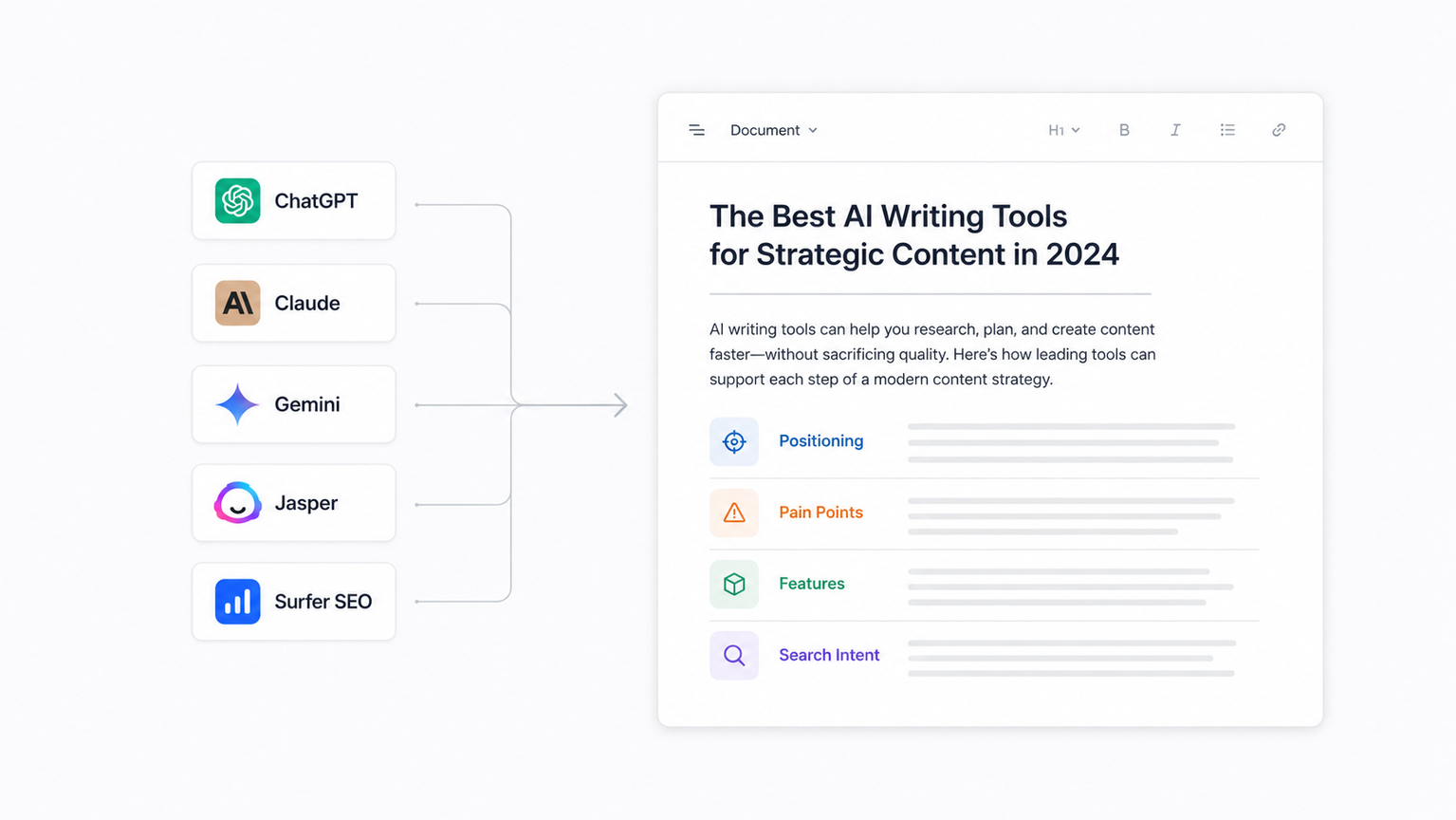
7 Best AI Writing Tools and How to Choose the Right One

Devesh Khanal
Devesh is co-founder of both Wave Writer and Grow and Convert, the content marketing agency whose strategy and processes were the origin of founding Wave Writer.
May 15, 2026
AI tools for content writing can mean many different things. Some are generic text generators like ChatGPT or Claude that can write anything but don't understand your business. Others are SEO optimization tools like Clearscope or Frase that help you rank but don't write for you. Then there are marketing copy generators like Jasper or Copy.ai that speed up ad copy and social posts.
Each type has a different use case: generic LLMs are great for brainstorming and quick drafts, SEO tools help you compete in search, and specialized copywriting tools handle short-form marketing content at scale.
But here's what most discussions of AI writing tools miss: the biggest challenge with AI content writing is that most of it isn’t great and therefore takes hours of editing to get it to sound like you and talk about your brand the way you do.
The real problem behind this AI writing quality issue isn’t about voice or style, it’s about substance.
Content “sounds like AI” because it’s not making the arguments you want. In fact, it’s often not making any substantive argument at all, just regurgitating words other people commonly use in a space. This is what everyone refers to as “AI slop”.
The solution to this is finding a tool that understands the substance behind your business—your positioning, your features and benefits, your customer pain points, and how you actually talk about your products. Without that understanding, you're stuck with generic AI slop. It’ll take hours of editing and not sound like your brand.
Below, we’ll cover popular AI writing tools people use for content writing, specifically marketing content, starting with a deep dive into our own, Wave Writer, and why we designed it the way we did.
What to Actually Look for in an AI Writing Tool (Beyond Features and Pricing)
The biggest pitfall when evaluating AI writing tools is focusing on surface-level features like word limits, templates, and integrations while ignoring the fundamental question: does this tool understand what you're trying to say about your business, or does it just imitate how you say it?
Most AI writing tools are wrappers around the same underlying language models (GPT-5, Claude, etc.), which means the real differentiator isn't the AI engine itself—it's how the tool is designed to understand your business context, guide your content strategy, and maintain your brand's substance across pieces.
To solve this deeper issue, we think you should evaluate AI writing tools with two simple questions.
(1) Does It Have a Way of Understanding Your Business, Not Just Writing Style?
Look for tools that learn from comprehensive business sources—product documentation, value propositions, positioning statements—rather than just analyzing a few past articles for tone and style. Tone is easy to adjust, but substance requires deep understanding of your products, features, customer pain points, and competitive positioning.
(2) Does It Give Reasoning and Understanding, Not Just Raw Writing Output?
Consider whether the tool helps with content strategy and ideation or just speeds up execution. The best tools analyze search intent, suggest content angles that align with your positioning, and guide you on how to introduce your products naturally within content rather than forcing generic sales pitches.
Wave Writer: The AI Writing Tool That Learns Your Business Substance, Not Just Your Style
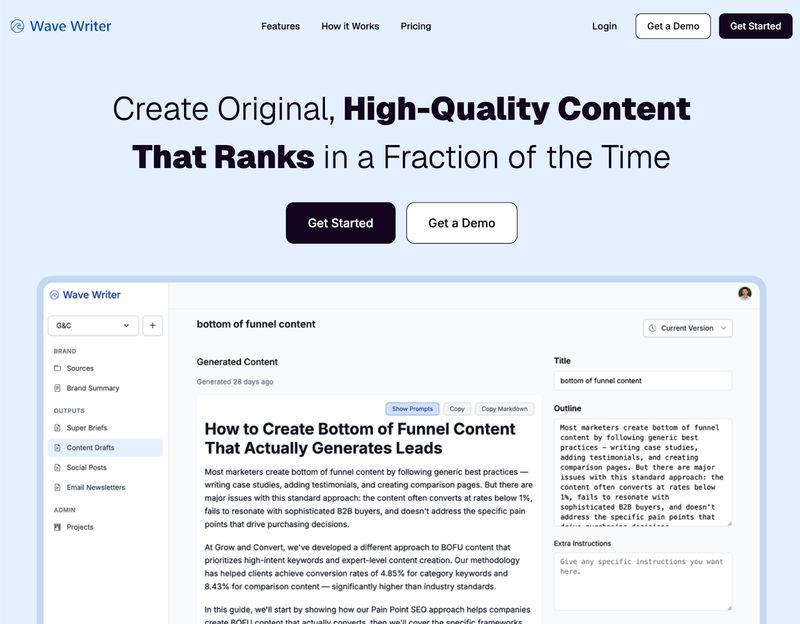
Wave Writer was created by the founders of Grow & Convert, a content marketing agency that’s been working with everyone from startups to public companies for a decade. So we’re practitioners of content writing, who have high writing quality standards.
It was when we started exploring AI writing that we noticed this problem: that existing AI writing tools focus on imitating brand voice and tone—which is relatively easy to adjust—while ignoring the substance behind a company's products, positioning, and messaging. The writing quality was just bad.
But we saw where the content writing industry was going. People were using AI writing in droves and just dealing with the bad writing. They felt like it saved them time even if it required a ton of editing.
So we asked ourselves: what if an AI writing tool understood your business first? Not just style but substance. What if it knew your products, features, benefits, value props, differentiators? What if it knew your customers, their pain points, and the use cases your products solve?
That’s Wave Writer.
It gets this understanding by first requiring users to upload comprehensive sources about their business—blog posts, value propositions, product documentation, positioning statements—and from these sources creates a detailed brand summary that captures what the business is, its features, customer personas, pain points it solves, and competitive alternatives.
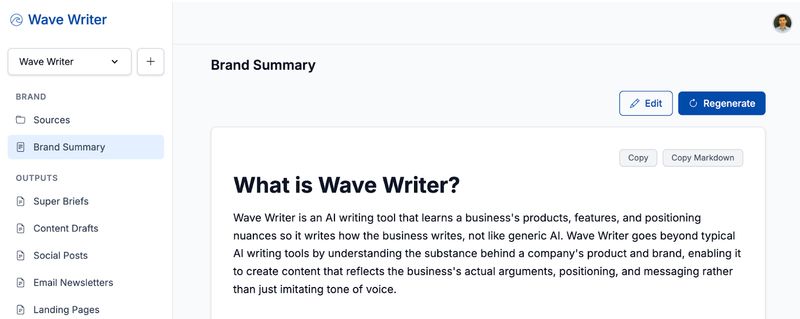
This brand summary becomes Wave Writer's understanding of the business and can be edited by users to ensure accuracy.
Super Briefs: Strategic SEO Content Planning Beyond Keyword Lists
Super Briefs are Wave Writer's comprehensive SEO analysis and content planning documents that go far beyond typical content briefs, which tend to be shallow and focus on formatting requirements like word count and heading structure rather than strategic substance.
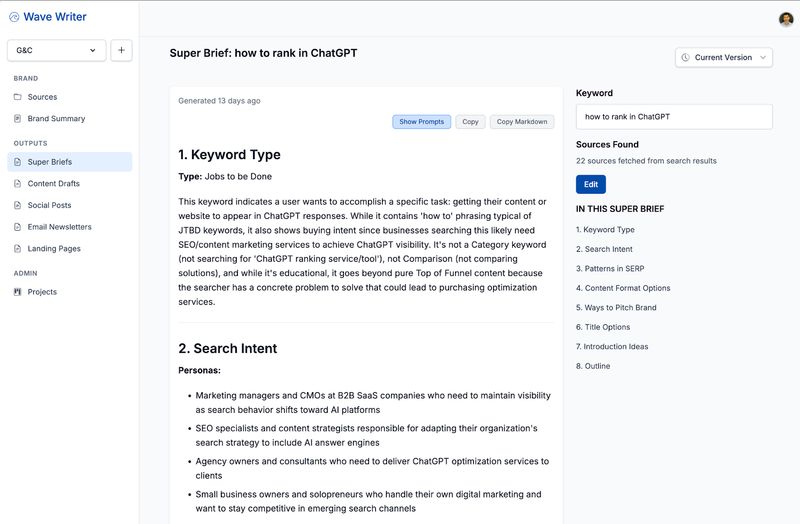
When you give Wave Writer an SEO keyword, it automatically performs smart keyword and intent analysis to determine who is likely searching (which of your customer personas), what problem they're trying to solve, and what type of content Google is actually rewarding for that query.
Wave Writer reads and analyzes the actual content of top-ranking results on the SERP—not just headlines—to identify patterns in page formats, content depth, recurring themes and frameworks, and notably what types of pages aren't ranking (like thin content or pure product pages).
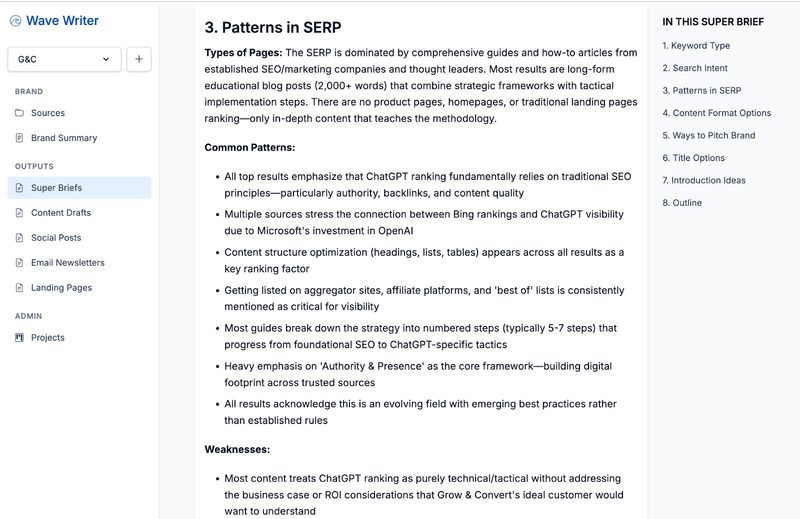
Based on this analysis and its understanding of your business, Wave Writer suggests strategic content angles that fit the search intent, recommends which of your product features or benefits make sense to introduce for this specific keyword, and shows how to incorporate your perspective without forcing a sales pitch where it doesn't belong.
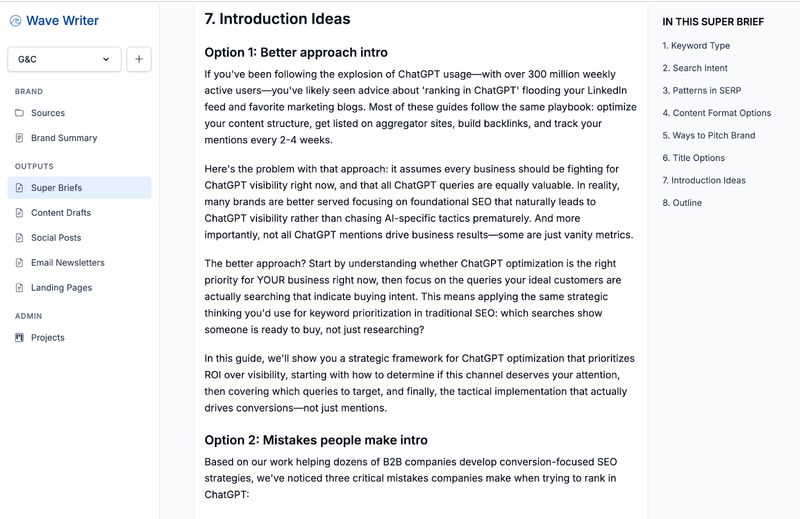
Super Briefs include multiple fully-written introduction options based on different intro frameworks. Wave Writer has been taught when to use each framework depending on keyword type and search intent, so you're not stuck with the same predictable AI-generated opening every time.
For body sections, instead of providing a single rigid outline, Wave Writer suggests multiple sections with explanations of why each is included: how it supports ranking, how it satisfies search intent, and how it contributes to clarity or conversion. This makes it especially useful for experienced writers and editors who can evaluate and refine suggestions with confidence.
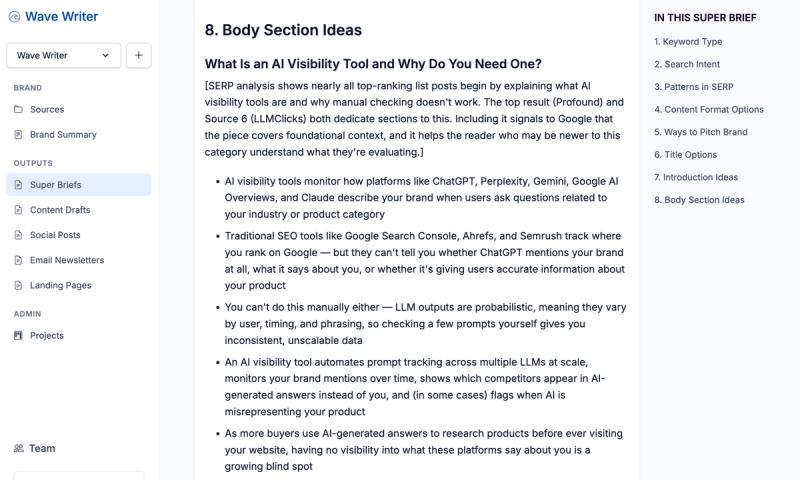
These briefs work as a shared source of truth whether you're writing the piece yourself, handing it to a freelancer, or feeding it into AI for drafting—ensuring everyone understands not just what to write but why and how to position it.
Content Drafts That Reflect Your Actual Positioning
Once you have an outline—either created yourself or generated from a Super Brief—Wave Writer can produce drafts that reflect how your company actually communicates because it has been trained on your existing content and understands your positioning, how you talk about features, and which benefits you emphasize versus which you don't.
This leads to drafts that feel far closer to something you'd actually publish instead of generic output requiring heavy rewriting—the typical complaint with most AI writing tools that don't understand your business context.
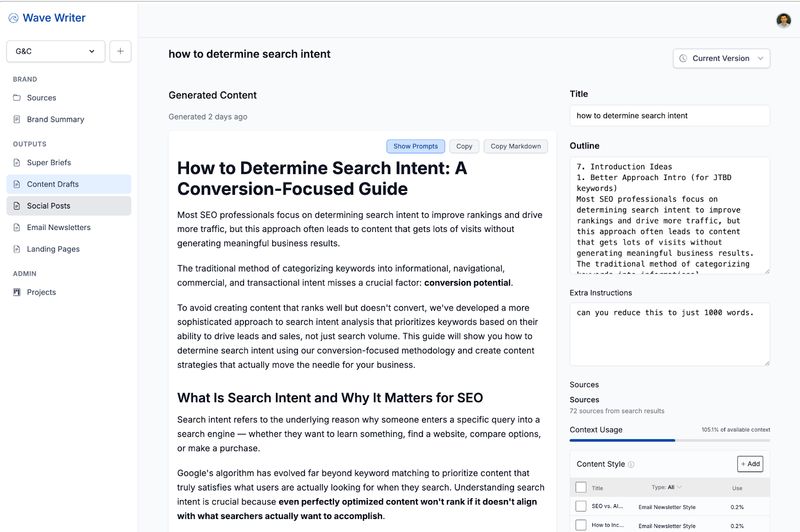
Wave Writer has been carefully trained to follow outlines faithfully. If an outline has a complete thought, it keeps that thought and builds around it rather than hallucinating random content or going off on tangents unrelated to your business.
When you provide rough, half-written ideas in an outline (even with typos or incomplete sentences), Wave Writer fills in the blanks based on its understanding of your business, turning brief notes into full sentences that discuss your features, benefits, and positioning the way your team actually talks about them.
In our experience, Wave Writer’s drafts require far less editing than typical AI outputs because they already incorporate your actual arguments and positioning, requiring only refinement rather than complete rewriting.
Beyond Blog Posts: Landing Pages, Social Media, and Email Content
Wave Writer isn't limited to blog content. It generates landing page copy when you tell it what the page is about, which features or ideas to emphasize, and the level of detail you're targeting.
For landing pages, Wave Writer can produce multiple headline options, both long-form and short-form copy variations, and alternative ways to frame the same feature or benefit so you can test different approaches.
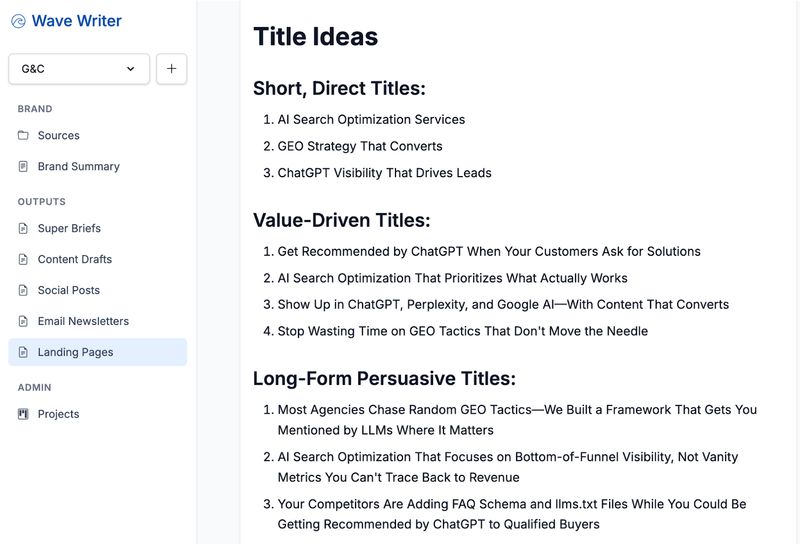
You can share example landing pages (yours or competitors') and Wave Writer will read them to understand structure, tone, and positioning, then apply those insights to your content while maintaining your brand's substance.
For social media, Wave Writer creates posts that match your company's voice by either feeding it content to extract key points from, sharing rough bullet points or partial thoughts, or referencing specific products, features, or positioning you want to highlight.
Because Wave Writer has been trained on your past social posts, it can identify what's actually noteworthy in your content and turn it into social posts that sound like your brand instead of generic "AI-written" updates that are obviously automated.
Wave Writer can help produce email newsletters more efficiently by training it on your past newsletters, then feeding it new content to get a concise summary written in your newsletter style, maintaining consistency across all your communication channels.
Pricing
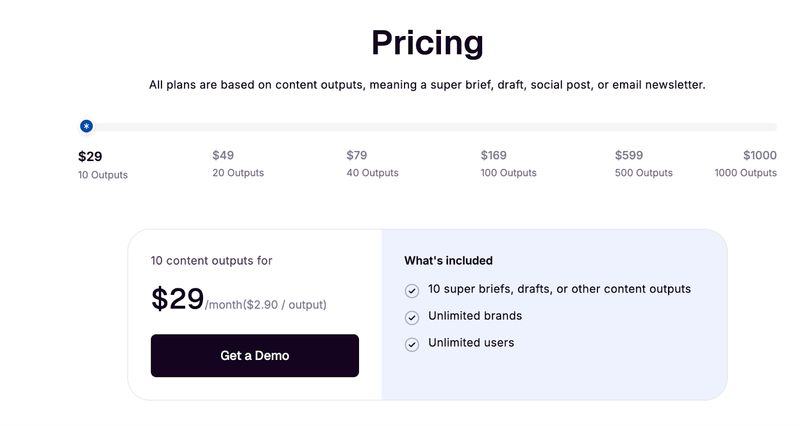
Wave Writer starts at $29/month for 10 outputs. All plans come with all features. Unlimited brands. Unlimited users. And as many sources to have Wave learn your business as our token limit allows (effectively 30 to 60+ depending on size).
ChatGPT and Claude: Great Free AI Writing Tools for General Use
In the survey that Grow & Convert did of how marketers are using AI writing, the #1 tool (by a wide margin) that marketers said they had used to help produce content was ChatGPT.
Claude and Gemini were second and third.
These are general purpose LLMs that are of course widely used to help people with all kinds of writing, including marketing content.
Because they’re general LLM chat bots, their biggest strength is flexibility. You can start with absolutely nothing or voice dictate some rough ideas and it’ll help you organize it, search the web for what others are saying or to find data to back up your points or just give you general feedback.
But here’s the rub, those same marketers who are mostly using ChatGPT, Claude and Gemini are also reporting heavy editing demands:
Over 60% said they either had to edit “a lot” or “essentially had to rewrite it”.
The reason is what we discussed at length below. Unless you carefully manage and prompt these tools, they won’t make the arguments you or your brand would make. It won’t convey your features and benefits the way you would.
The simplest solution to this is to set up a project and feed it a bunch of your past material but in our (and others’) experience, these LLMs tend to forget what you teach it over time. The first chat or two work well but slowly it reverts back to its old habits and hallucinations.
Jasper AI: Marketing Copy at Scale with Brand Voice
Jasper is one of the other common names we hear in this space. It markets itself as AI that’s “purpose built” for marketing teams. It comes with a ton of templates of different content types you can produce.
In terms of learning about your business, when we tested it, it only had a “Brand IQ” feature that learned tone and style, which still did not solve the lack-of-substance problem we outlined above.
But as of this writing they seem to also have created “Marketing IQ” and “Knowledge Base” features which seem similar to how Wave Writer learns about the substance of your business. We haven’t tested if this improves the actual writing quality output, yet.
Jasper starts at $59/m for one seat. Crucially, this plan limits you to only 5 knowledge assets, meaning you can only give Jasper limited context about your brand and products. In contrast, all Wave Writer plans let you upload what’s effectively an unlimited amount of sources, within our context or token limit.
Clearscope: Content Optimization for Search Rankings
Clearscope is at its core a content optimization tool, one we’ve used and loved for years, but has recently added AI writing features such as outlining and SERP analysis.
It analyzes patterns in what’s already ranking for an SEO keyword and helps you include the relevant topics and keywords (“entities”) to help you rank.
Its keyword research and content optimization features work by analyzing top-performing content for target keywords and providing recommendations for semantic keywords, content structure, and optimization opportunities.
Clearscope's strength lies in its ability to help content creators understand what Google rewards for specific search queries, making it valuable for SEO professionals who need data-driven insights about content performance.
At $170+ per month, Clearscope is positioned as a premium SEO tool for teams that prioritize search rankings and have budget for specialized optimization software.
The limitation is that Clearscope doesn't write content for you—it provides optimization guidance that still requires human writers or separate AI tools to execute, making it complementary to rather than competitive with AI writing platforms.
Copy.ai: Fast Social Media and Marketing Copy
Copy.ai specializes in generating short-form marketing content quickly, making it particularly useful for social media marketers who need to produce high volumes of posts, captions, and ad copy.
The platform offers a free plan (limited to 10 credits per month), which makes it accessible for individuals and small businesses testing AI writing tools without financial commitment.
Copy.ai's advanced drafting wizard gives users more control over the output, and the platform includes knowledge-sharing features that help social media marketers connect with other users and learn best practices.
At $49 per month for small business accounts, Copy.ai is more affordable than many competitors, though you'll need custom enterprise pricing to unlock unlimited credits.
The main weakness is that Copy.ai isn't designed for long-form content like blog posts or in-depth articles—it's optimized for quick, short-form marketing copy, so teams with diverse content needs will find it limiting.
Like most AI writing tools, Copy.ai focuses on speed and format variety rather than understanding your business substance, meaning the content still requires editing to ensure it accurately represents your products and positioning.
Grammarly: AI-Powered Editing and Writing Assistance
Grammarly is fundamentally an editing and writing assistance tool rather than a content generator—it catches spelling mistakes, grammatical errors, and suggests improvements to clarity, conciseness, and engagement as you write.
The platform's real-time recommendations work across nearly everywhere you write: Google Docs, Microsoft Office, email clients, and web browsers through extensions, making it seamlessly integrated into existing workflows.
Grammarly analyzes not just correctness but also tone, formality, and readability, helping ensure your content aligns with your intended audience and brand voice.
The free version is surprisingly feature-rich and handles most basic editing needs, while premium features include advanced style suggestions, plagiarism checking, and more detailed writing insights.
However, Grammarly's AI writing features (like generating text from prompts) are much more limited than dedicated AI writing tools—it's better viewed as an editing companion rather than a content creation solution.
For content creators, Grammarly works best in combination with other tools: use an AI writer like Wave Writer to generate substance-rich drafts, then use Grammarly to polish grammar, style, and readability.
Rytr: Budget-Friendly AI Writing for Basic Needs
Rytr is one of the most affordable AI writing tools on the market, starting at just $9 per month, making it accessible for freelancers, students, and small businesses with tight budgets.
The platform offers customizable tone and creativity levels, letting users adjust how formal or casual the output sounds and how creative versus straightforward the content should be.
Rytr includes a free plan with limited features, allowing users to test the tool before committing to a paid subscription.
However, both the free tier of ChatGPT and Claude produce higher quality output than Rytr while being completely free, which raises questions about whether Rytr's paid plans offer enough value for the cost.
Rytr is best suited for very basic content needs and users who specifically want a simple, no-frills interface rather than the more complex capabilities of free tools like ChatGPT—but for most users, the free alternatives will likely serve better.
Wave Writer has helped companies create content that ranks and converts by understanding their business substance, not just their writing style. Schedule a demo to see how Wave Writer can transform your content creation process.