AI SEO Content Writer: The 3 Categories of SEO Content Tools and How to Choose

Devesh Khanal
Devesh is co-founder of both Wave Writer and Grow and Convert, the content marketing agency whose strategy and processes were the origin of founding Wave Writer.
July 16, 2026
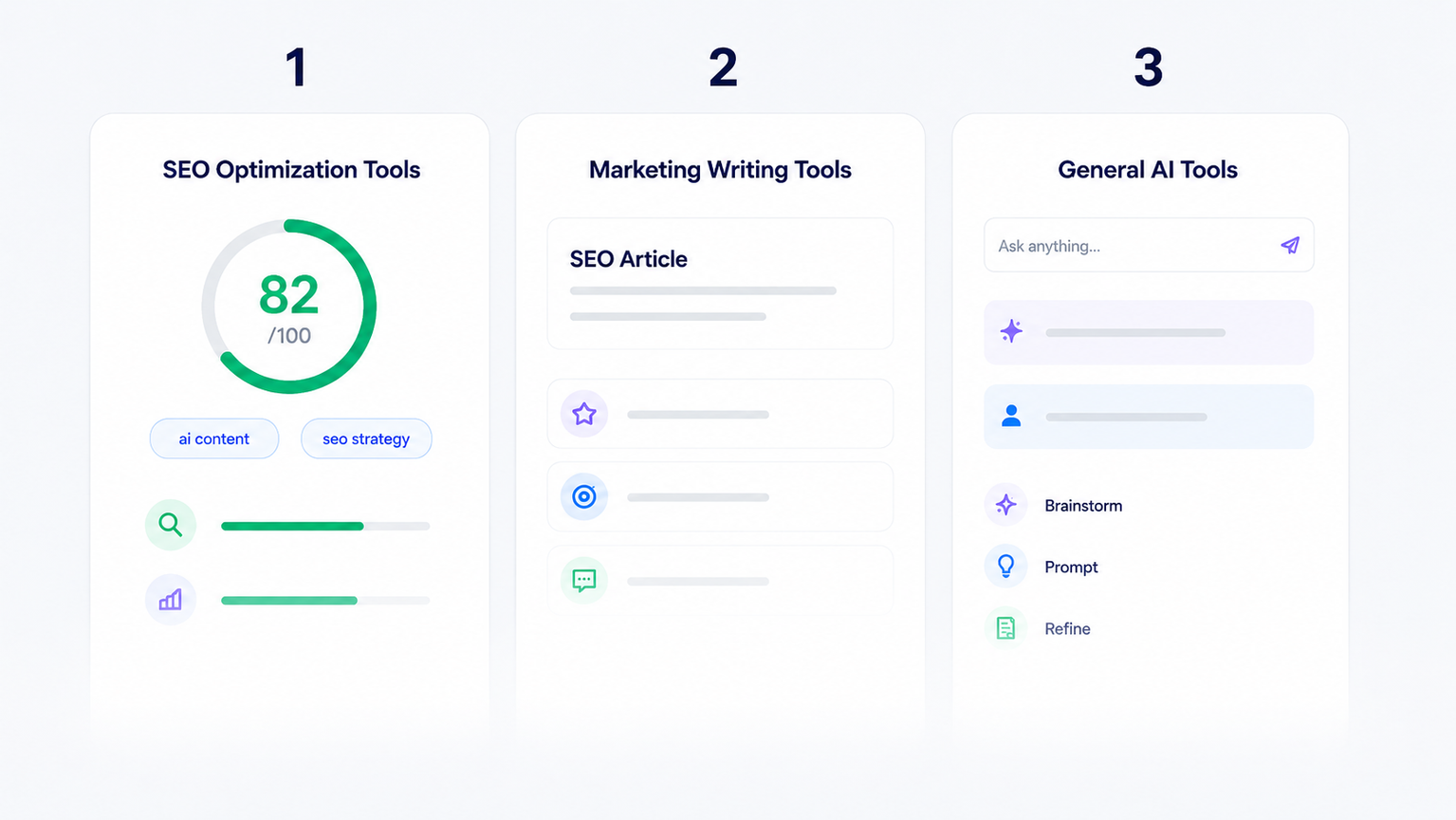
There are dozens of tools that could call themselves an AI SEO content writer, but most of them don’t actually do the same thing. So we’ve noticed, in our experience, that many marketers confuse tools that aren’t quite in the same category and assume one type of tool will do the other’s task. This can lead to frustration. Specifically, it’s useful to think of AI tools for content generation (ni particular SEO) in two buckets (roughly speaking):
On page SEO optimization tools - These are tools like Clearscope and Surfer. While they all seem to be releasing new AI features all the time that promise to help you write your full article, their DNA is to be an on-page optimization tool, not a marketing content writing tool first (I’ll explain why that matters and what that means below). These tools typical excel at things like telling you what keywords or “entities” to include at your content and giving you a grade or a score for that. They aren’t as good as generating marketing copy that is good, which in today’s world of AI is a precious commodity. Good, in this case, means it expresses your brand voice properly, positions your product accurately, and more. In other words how close the AI generated content matches what you and your brand want, and how long does it take for you to edit it to get to that desired end goal.
Marketing writing tools - These are tools like Jasper and our tool, Wave Writer whose aim is to generate good marketing copy. These tools focus on helping you actually write the body copy of SEO content well, not just add keywords at the end.
General purpose AI tools - Finally there are general purpose AI tools that many writers use for content generation, the most popular of course being Claude and ChatGPT but even Grammarly can fall into this category.
Regardless of which tools you are evaluating, we think the following questions or factors to consider are important to ask yourself if you want to generate high-quality SEO content with AI assistance:
Does the tool understand your business substance, not just your writing style? Tone is easy to adjust. Knowing which features to emphasize, what arguments to make, and how to position your product is what separates useful AI content from generic filler.
Does it analyze search intent and the SERP, or just write? A good AI SEO content writing tool should help the marketer understand and analyze the SERP in order to help itself and the human using it produce a better end product. That means really understand who's searching, what they need, how that overlaps with the product and the brand’s ideal customer profile (ICP), and what's already ranking. A bad tool skips all of this and just produces words.
Does it explain its reasoning? Can you see why it's suggesting a particular angle, section, or product mention, or are you expected to trust it blindly? The best tools, in our minds, explain why each section is necessary or useful.
Does it require heavy editing to sound like your brand? This is the ultimate test. If you spend hours rewriting every draft in order to avoid Google helpful content penalties or just not have your content sound like AI, then the time savings of the tool vanish.
Then, we'll compare 7 AI SEO content writer options starting with our platform, Wave Writer, which was built by the founders of a content marketing agency to solve exactly these problems.
What to Look for in an AI SEO Content Writer (Beyond Features and Pricing)
In our experience, the biggest mistake when evaluating AI SEO content writers is focusing on surface-level features like word limits, template libraries, or number of integrations while ignoring the fundamental question: does this tool understand what you're trying to say about your business, or does it just imitate your writing style?
This distinction matters more than most people realize.
Most AI writing tools are wrappers around the same underlying language models (GPT-4, Claude, etc.), so the real differentiator isn't the AI engine. It's how the tool is designed to understand your business context, guide your content strategy, and maintain your brand's actual substance across pieces.
Here's what we think you should be evaluating:
Factor 1: Does it understand your business substance, not just your writing style?
This is the one that gets overlooked the most. A lot of AI writing tools let you upload a few past articles, but what they do from that is just learn your brand voice, i.e. how you write. They imitate your tone, sentence structure, how long you want paragraphs or sentences to be. You can even write something in the wrong tone and then upload it into ChatGPT and change the tone. This is not hard. You do not need a dedicated tool to imitate brand voice. Claude or ChatGPT can do that all day for you.
Let me say this clearly: Changing the tone or voice of our piece, or eliminating em dashes, is not what saves you from AI slop.
What differentiates good copy from AI slop is what it says substantively. The arguments. Does it make real, substantive, coherent arguments or is it just cute sounding writing that sounds polished but when you really sit down to read it you realize it doesn’t really say anything? The latter is AI slop and Google, and your customers are gettin gmore tired of that writing every day.
Also, good SEO writing also pitches your product and differentiates your brand in a smart, intelligent way that is consistent with how the brand wants to talk about its products. That means: which features you're choosing to emphasize, what benefits you're pairing with them, how you're positioning against alternatives, etc.
To get that right, an AI tool needs to actually understand your products, your customer pain points, and your competitive positioning. It’s not enough to just imitate your writing style and remove em dashes.
Factor 2: Does it analyze search intent and the SERP, or just write?
A lot of AI SEO content writers work like this: you type in a keyword, it spits out an article. Maybe they ask you a few questions, but that's more or less it. No analysis of who's actually searching for that keyword, what problem they're trying to solve, or what type of content Google is rewarding for that query.
The best AI SEO content writers help you understand the landscape before you write. That means analyzing the SERP to see what's ranking and why, identifying the searcher's actual intent, and helping you figure out an angle that can compete, not just generating text that includes the keyword a certain number of times.
Factor 3: Does it provide reasoning behind its suggestions?
This is one that comes from our own frustrations trying to produce high quality content with AI assistance and thus a feature we built into Wave Writer that we have grown to love. Most AI tools just spit out copy. And you’re left to deal with it. If a section doesn’t sit right with you, you have no idea why it suggested it. That’s annoying. So see if you can find a tool that, when it suggests a particular content angle, section, or product mention, it explains how that section supports ranking, how it satisfies search intent, or how it contributes to conversion.
Factor 4: Does the output require heavy editing to sound like your brand?
This is the ultimate test of whether AI is helping you or not. If you spend hours or rewriting every draft because the AI got your product details wrong, made generic arguments instead of your specific arguments, or just produced content that could be about any company in your space, in our opionin, you need a better tool.
The ultimate test is whether, during editing, you ask yourself: Why didn’t I just write this myself?
The whole point of using an AI writing tool is to get a draft that's close enough to what you'd publish that you're refining, not rewriting. That only happens when the tool actually understands what your business does and how you talk about it.
Let’s evaluate several SEO writing tools in that lens starting with a deep dive in how we designed our own, Wave Writer, to fulfill the criteria above.
Wave Writer: The AI SEO Content Writer Built for Smart Analysis and Extremely High Quality Content Generation
Our tool, Wave Writer was born from our day to day work at Grow & Convert, a content marketing agency that's built its brand on extremely high quality content. We’re actual practitioners of content writing with high quality standards, not tech bros trying to make a quick app riding on the AI craze.
We’ve explored countless AI writing tools for our own agency work, and noticed that almost all of them focus on imitating brand voice and tone while ignoring the substance behind a company's products, positioning, and messaging. The writing quality was consistently poor because the AI wasn't making the arguments the business would make. It was just parroting back the same tone in which the business writes, but saying nothing of substance.
We built Wave Writer to solve this by having it first read existing content that explains your brand and products in detail: blog posts, value propositions, product documentation, positioning statements, competitive comparisons. From that, it then creates a detailed brand summary capturing what the business is, its features, customer personas, the pain points it solves, and its competitive alternatives.
This brand summary becomes Wave Writer's understanding of the business, and you can edit it to ensure accuracy. It's not a black box. You can read exactly what Wave Writer thinks it knows about you, correct anything it got wrong, and add nuances it may have missed. Then everything it produces (drafts, briefs, social posts) is informed by that understanding.
Can’t I Do This in Claude or ChatGPT?
No. We tried, and two problems kept surfacing.
First, Claude and ChatGPT don’t read all the context each time they write. You can load your past content into a project, but the model doesn't reliably read it, so drafts routinely miss a detail you specifically uploaded. You end up correcting it: "No, don't say that, check the positioning doc, I explained it there." The only real fix is pasting your full context into every prompt, and no one has the patience for tens of thousands of words for each prompt. Wave handles all of this in the background for you, passing all the relevant context to the model when necessary, so nothing important gets skipped and you stop repeating yourself.
Second, it drifts and forgets over time. Both tools start strong, then slide back to their default AI voice over time, and you correct the same habits again and again. Wave controls exactly what the model sees and how it's prompted, so the quality holds. Doing that by hand would be miserable, which is why we built Wave: a controlled way to use the same underlying models, with output much closer to what you'd actually publish.
Super Briefs: Strategic SEO Content Planning Beyond Keyword Lists
This is one of Wave Writer's most differentiated features, and it's worth going into detail because no tool we’ve tested in the AI SEO content writer space does anything like it.
Most tools in this category work like this: you give it a keyword, it gives you an article. Maybe it asks you a few questions. Maybe it suggests some headings. Maybe it tells you to include certain related terms. But it doesn't help you actually think through the piece — who's searching for this, what they need, what's already ranking and why, and how your specific business should angle the content.
This thinking is what separates great SEO content from blah.
Wave Writer's Super Briefs do all of that.
Search Intent Analysis
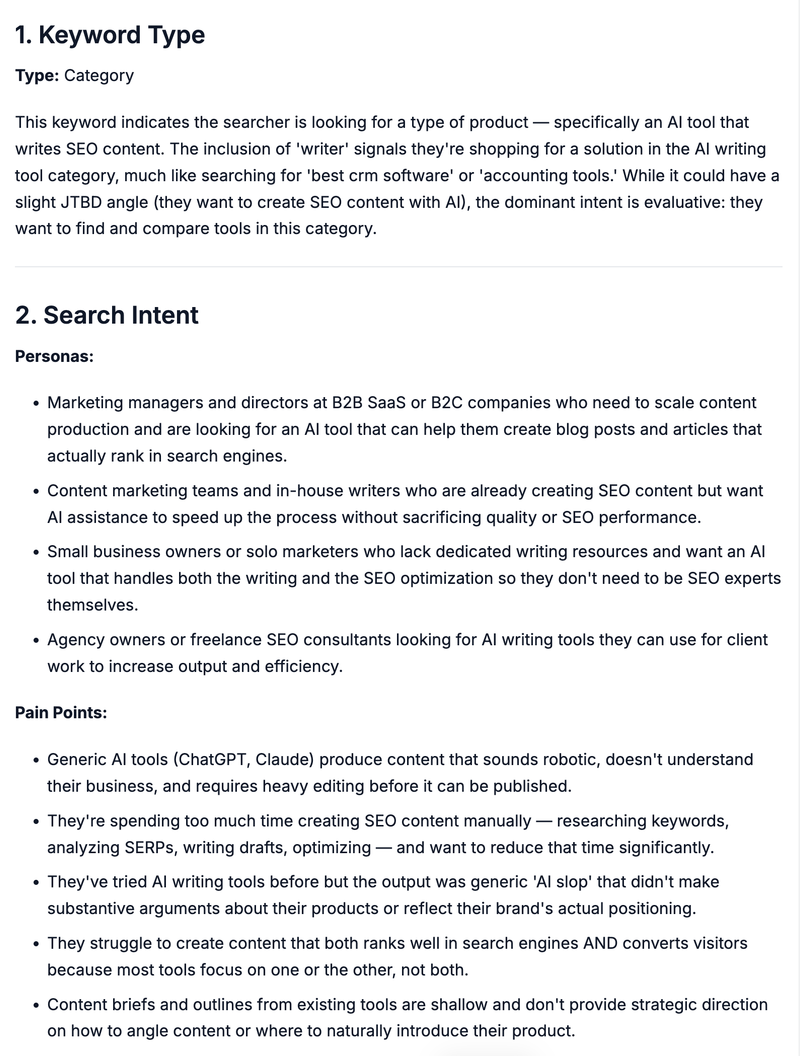
When you give Wave Writer an SEO keyword, it automatically performs keyword and intent analysis. It determines who is likely searching (which of your customer personas), what problem they're trying to solve, and what type of content Google is actually rewarding for that query. It uses Grow & Convert's Pain Point SEO methodology to categorize keywords into intent buckets — category keywords (bottom of funnel), comparison and alternative keywords, jobs-to-be-done keywords (more top of funnel) — so the brief is grounded in a real strategic framework, not just keyword density.
Here is that analysis from Wave for this exact piece you’re reading now, targeting ‘ai seo content writer’:
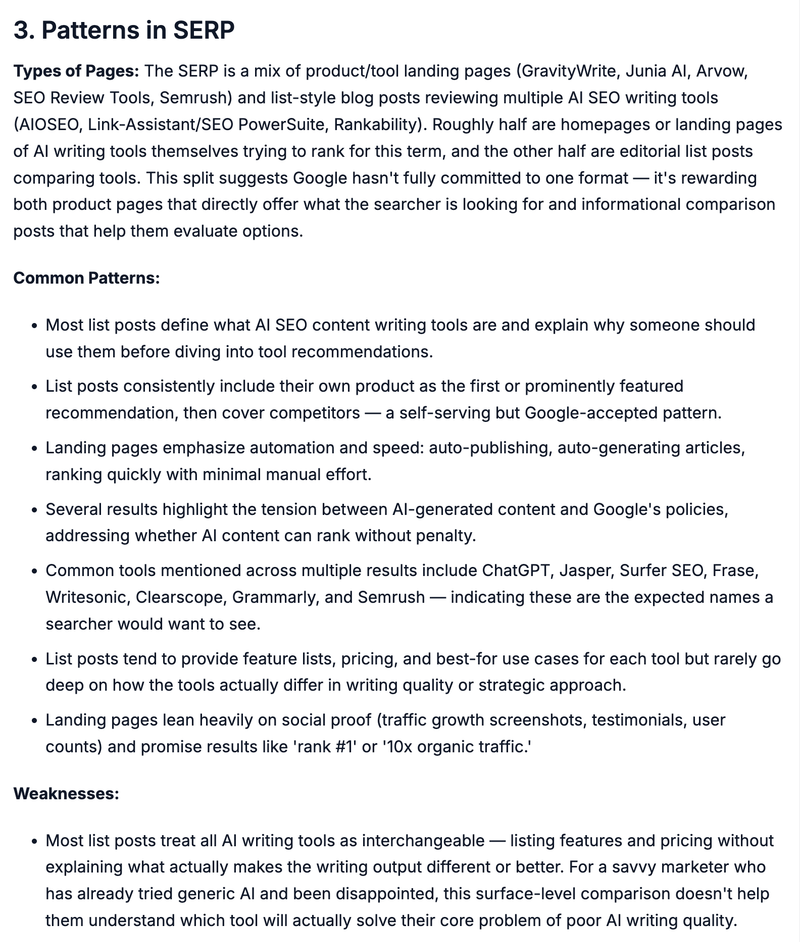
SERP Analysis
Then Wave Writer fetches, reads and analyzes the actual content of the first 10 results on the SERP. Not just the headlines, it reads the first 1000 words of each piece and analyzes patterns in what arguments they are making. What Google seems to be favoring for this keyword and, importantly, what the weaknesses of these pieces seem to be. In our experience having filtered through thousands of freelance writer applications and trained and worked with hundreds of writers over the years, this is more in depth than what most freelancers do when given a keyword.
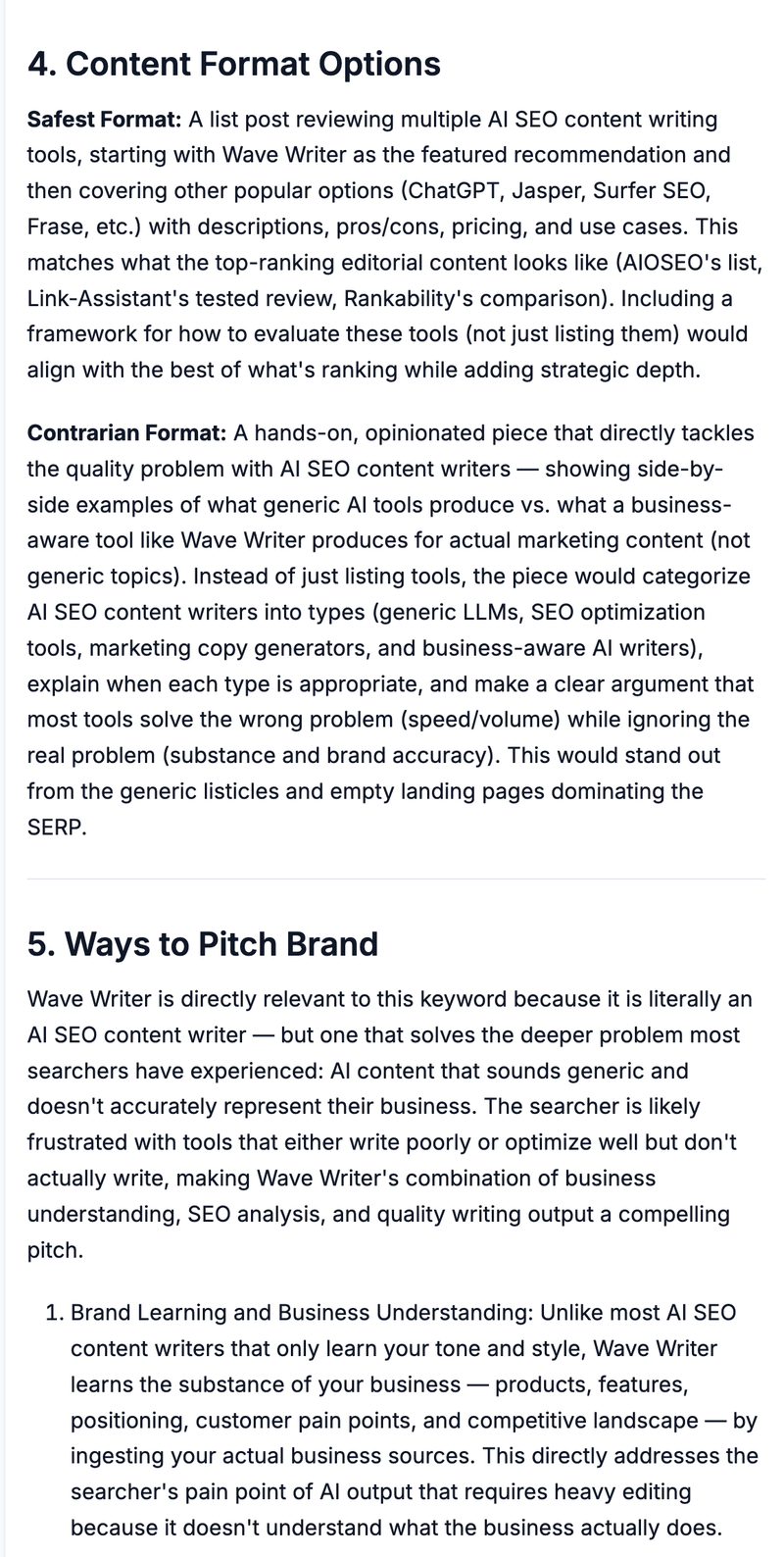
Content Format Options and How to Pitch Your Product
Based on this analysis combined with its understanding of your business, Wave Writer suggests strategic content angles that fit the search intent, recommends which of your product features or benefits make sense to introduce for this specific keyword, and shows how to incorporate your perspective without forcing a sales pitch. This is only possible because it understands your business. Most AI content writers don’t even think to pitch your product. And if they did think to, they wouldn’t know how because they are not built to have an in depth understanding of your product, features, and benefits.
Multiple Fully Written, High-Quality Intros
Super Briefs also include multiple fully-written introduction options based on different article intro frameworks taught to Wave via writers at Grow & Convert. We carefully taught Wave different intro frameworks that we use in our actual client work and when to use each one depending on keyword type and search intent. We’re obsessive about blog intros because they decide whether someone keeps reading or not. And we’re absolutely sick of bad AI intros (and in fact, bad human intros as well). So we made sure Wave didn’t product that slop. These intros are designed to match the reader's mindset, set up the article's unique angle, and avoid the generic patterns most AI tools fall into.
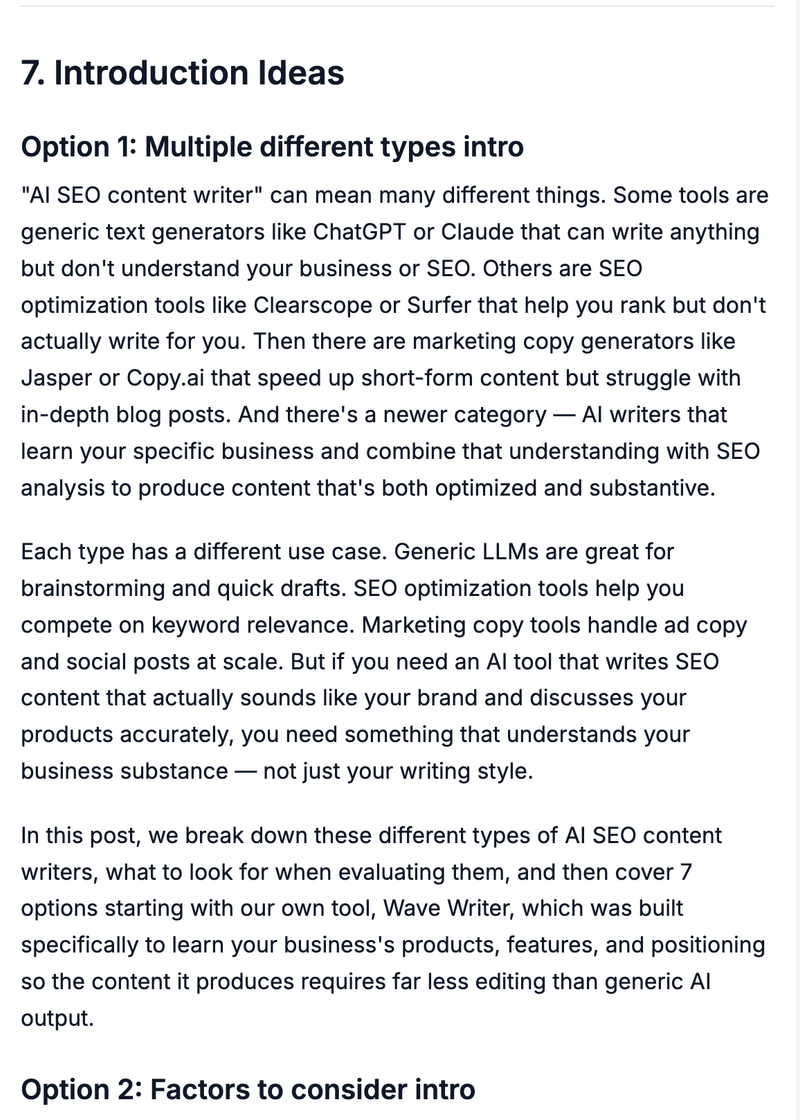
Body Section Ideas With Reasoning For Each
For body sections, instead of handing you a single rigid outline, we designed Wave Writer to suggest multiple sections with explanations of why each is included, like how it supports ranking, how it satisfies search intent, or how it contributes to clarity or conversion. This is designed as a buffet of ideas, not some fixed outline (although many Wave users prefer to just pass all of these to a draft as is, and that’s fine). It’s designed for a smart marketer to be able to (if they want) think through what sections make sense for this piece, in what order, reorder if they want, add, delete or edit as they want. This is what we mean when we say Wave Writer was built to use AI assistance to speed up writing but still enable extremely high quality content in the end.
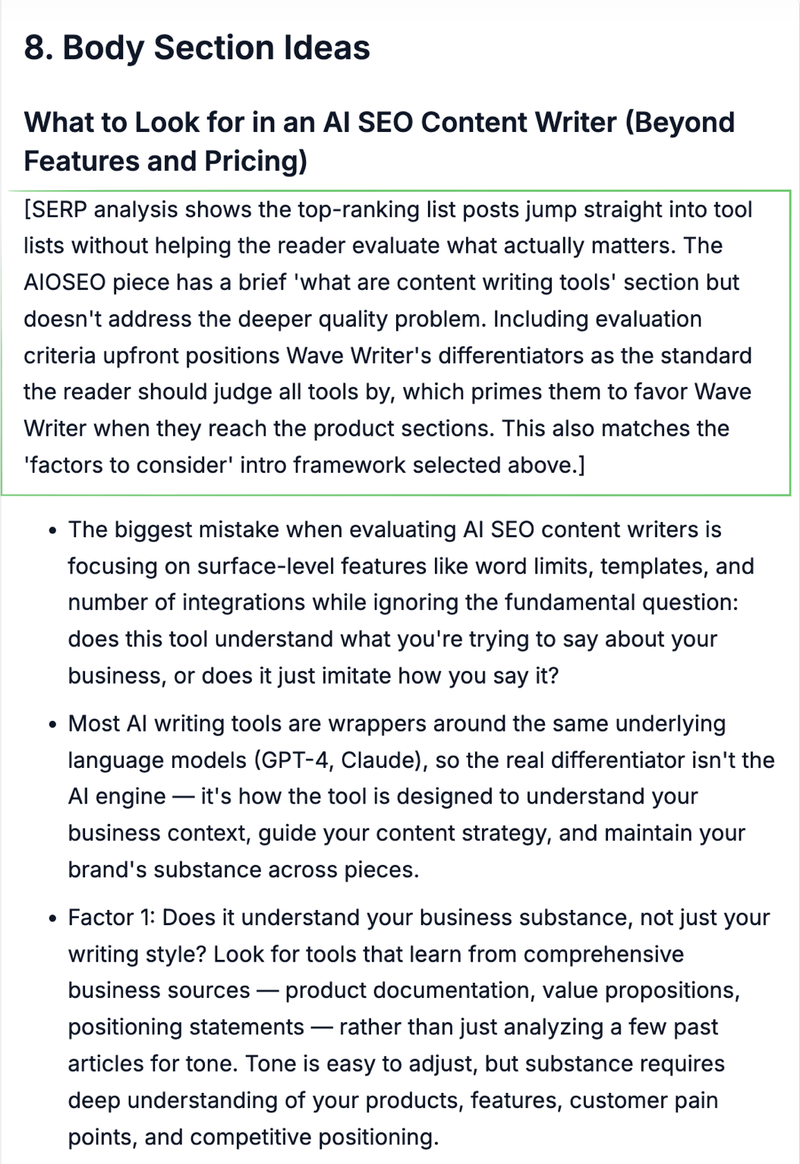
As part of that, notice the boxed section (box added by me for emphasis). Wave will give you it’s reasoning for each section so you don’t have to just blindly trust AI, but rather you’re understanding what it saw and why it suggests it and you can use your human reasoning to agree or disagree.
In Wave, we call these “Super Briefs” to play on the normal “content brief” that we’re all used to in the content and SEO space. Normal content briefs are mostly about the logistical details of the post like paragraph length and how many images to include. That’s not how you get high quality content. It doesn’t affect what you say.
Super briefs fix that. And they serve as a shared source of truth whether you're writing the piece yourself, handing it to a freelancer, or feeding it into AI for drafting.
Content Drafts That Reflect Your Actual Positioning
Once you have an outline — either one you created yourself or generated from a Super Brief — Wave Writer can turn that into a complete draft. The key differentiator for Wave here is the quality of that draft. Because it's been trained on your existing content and understands your positioning, it knows how you talk about features and which benefits you emphasize.
Here's what that looks like in practice. Wave Writer has been carefully trained to follow outlines faithfully. If an outline has a complete thought, it keeps that thought and builds around it rather than hallucinating random content or going off on tangents. It doesn't take your carefully considered argument and replace it with generic AI fluff.
When you provide rough, half-written ideas in an outline, Wave Writer fills in the blanks based on its understanding of your business, not generic ideas off the internet. You can write something like "explain why our approach to [topic] is different" and because Wave Writer has read your sources and understands your positioning, it will actually articulate your argument, not a generic version of it.
For example, in Grow & Convert's own use of Wave Writer, they'll put something like "explain the difference between strategy and tactics in the context of Pain Point SEO" in an outline, and Wave Writer doesn't explain it in some theoretical, textbook way. It explains it in the context of Grow & Convert's specific framework and philosophy, because it's ingested that content and understands what the company actually thinks about the topic.
You can also select specific pieces, interview transcripts, or background info to pass along to Wave for a specific draft to give it even mroe specific context and ensure the output is extremely high quality:
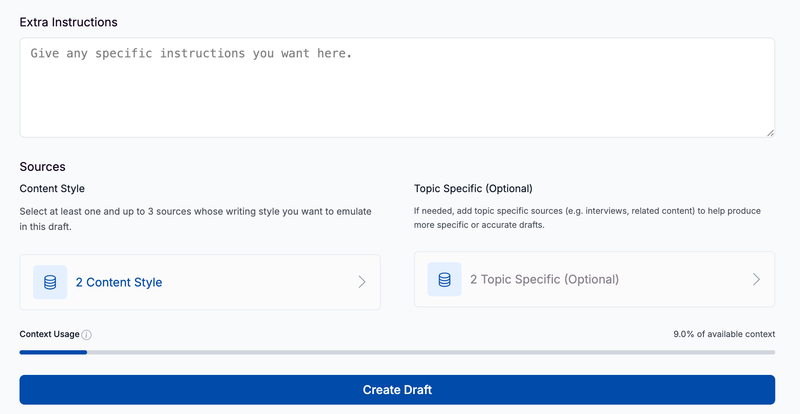
The result is drafts that require far less editing than typical AI outputs because they already incorporate your actual arguments and positioning. You're refining and making editorial choices, not rewriting from scratch.
Edit and Revise Without Juggling Tabs
Another annoyance we’ve had with AI writing is the process of editing it. If you use Claude or ChatGPT as your AI writing tool, it’s usually a juggle between two open tabs: your draft, and Claude/ChatGPT. You edit some things yourself, you go and ask it to revise other sections and you copy and paste things back and forth. You find something you want to change, you go copy it into ChatGPT, explain what you want, copy the output back, paste it in, realize it lost the context of the surrounding paragraphs, try again. It's tedious.
So we built an edit feature into Wave Writer that lets you make both exact edits (when you know exactly what to change) and Wave-assisted edits (when you want the AI to help revise a section), right in the draft, without leaving the tool.
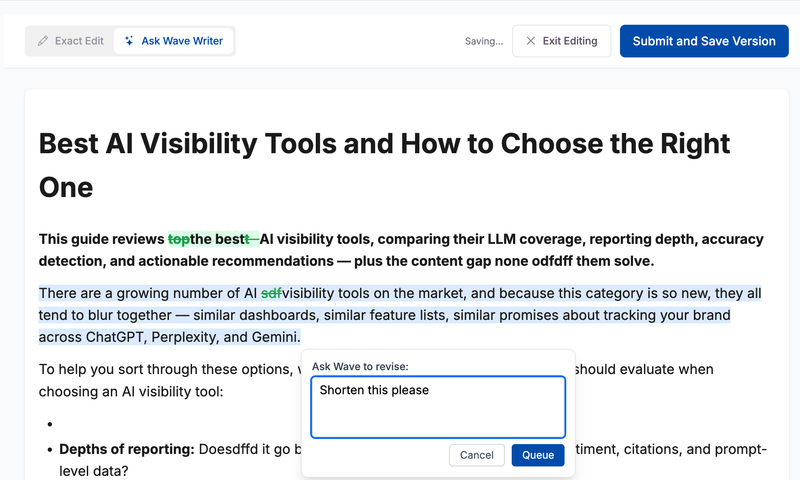
Click where you want to make direct edits yourself (shown in green above), or highlight a section and ask Wave to revise it with specific instructions.
Wave Writer also keeps version history so you can see what changed and easily go back to previous versions.
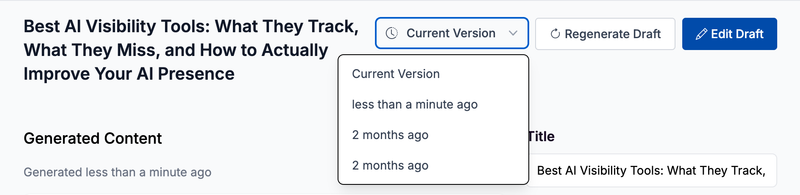
Everything related to a draft lives in one organized place. You're not digging through past chat threads trying to find that one version where the intro was better. All previous versions are right there, and you can see exactly what you changed between each one.
Beyond Blog Posts: Landing Pages, Social Media, and Email Content
Wave Writer's business-understanding advantage isn't limited to SEO blog posts. The same deep knowledge of your products, positioning, and messaging extends to other content types.
Landing page copy: Tell Wave Writer what the page is about, which features to emphasize, and the level of detail you want. It generates multiple headline options, long-form and short-form copy, and alternative ways to frame the same feature or benefit. You can also share example landing pages (yours or competitors') and Wave Writer will read them to understand str
ucture, tone, and positioning, then apply those insights while maintaining your brand's substance.
Here’s an example of it’s output when I asked it to help with the new Wave Writer homepage.
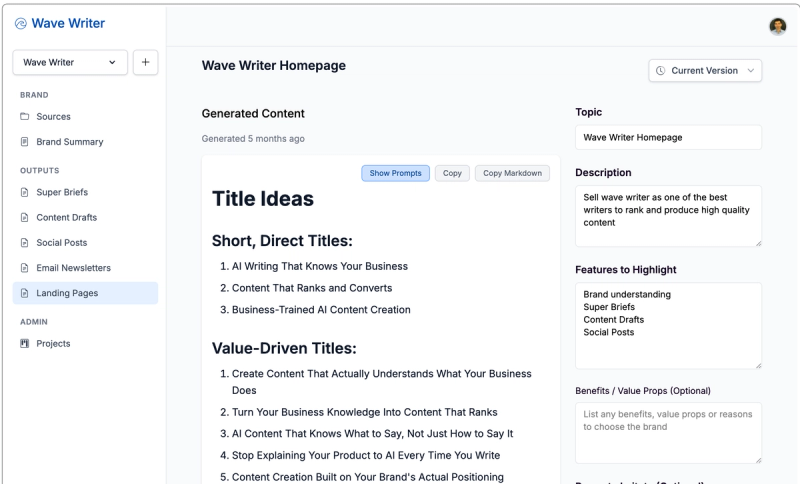
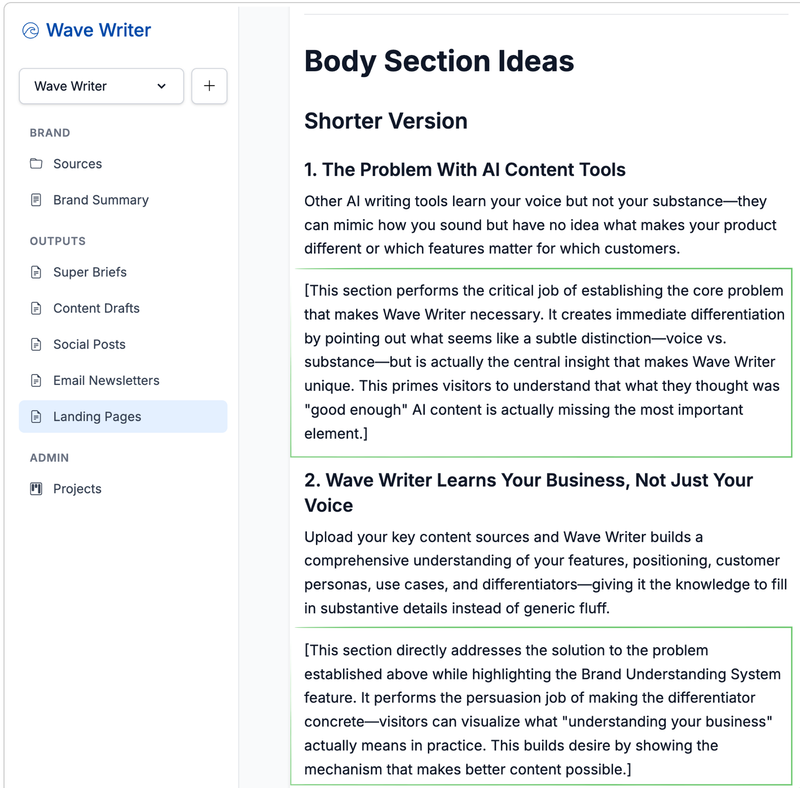
Again, just like the outlines, it gives you reasoning for each body section it’s suggesting:
Social posts: Wave Writer creates posts that match your company's voice. Feed it content to extract key points from, share rough bullet points or partial thoughts, or reference specific products and positioning. Because it's trained on your past posts, it identifies what's actually noteworthy and turns it into social posts that sound like you wrote them — not generic AI-written updates. You can also give it a style source (like a collection of your best LinkedIn posts) so it imitates your specific social media voice.
Email newsletters: By training on your past newsletters, Wave Writer helps produce email content more efficiently. Feed it new content and get a concise summary written in your newsletter style, so you're not starting from scratch every time.
Wave Writer Pricing
Wave Writer starts at $29/month for 10 outputs per month.
All plans come with every feature — Super Briefs, content drafts, landing page copy, social posts, email newsletters — nothing is locked behind higher tiers.
Every plan includes unlimited brands and unlimited users, so teams and agencies can use it across multiple clients without per-seat charges.
You can upload as many sources as the token limit allows (effectively 30 to 60+ depending on source length) to teach Wave Writer your business. Compare that to Jasper's starter plan, which limits you to only 5 knowledge assets — meaning you can only give Jasper very limited context about your brand and products before you need to upgrade.
ChatGPT and Claude: Great Free AI Writing Tools for General Use
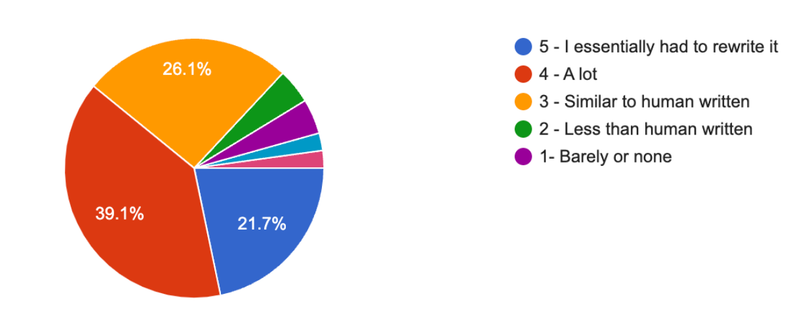
In a survey by Grow & Convert of how marketers use AI writing, ChatGPT was the #1 tool by a wide margin, with Claude and Gemini second and third. If you're reading this article, you've almost certainly tried one or both.
Their biggest strength is flexibility. You can start with nothing, brainstorm, search the web, get feedback, and iterate on virtually any type of content. For quick brainstorming, rough first drafts, or non-marketing content, they're excellent free options.
But those same marketers reported heavy editing demands: over 60% said they either had to edit "a lot" or "essentially had to rewrite" the AI output.
The core issue is that unless you carefully manage and prompt these tools, providing detailed context with every session, they won't make the arguments your brand would make or convey your features and benefits the way you would. They have no persistent understanding of your business. Every new conversation starts from zero unless you manually set it up again.
You can set up a project inside ChatGPT and feed it past material, and that helps initially. But in practice, these LLMs tend to forget what you teach them over time. The first few chats work well, but the tool slowly reverts to generic habits and hallucinations. Wave Writer is built differently, its brand understanding is carefully controlled so that every time it generates content, it's pulling from the sources you've uploaded and the brand summary it's created. It doesn't drift.
For SEO content that needs to accurately represent your business, the editing time with raw ChatGPT or Claude often erases the time savings you thought you were getting.
Jasper AI: Marketing Copy at Scale with Brand Voice
Jasper is one of the most well-known names in AI writing and markets itself as AI "purpose-built" for marketing teams. It comes with a large library of templates for different content types — ads, social posts, blog posts, landing pages — which makes it easy to get started quickly across a variety of formats.
For learning about your business, Jasper originally had a "Brand IQ" feature focused on tone and style, and has since added "Marketing IQ" and "Knowledge Base" features that appear similar in concept to how Wave Writer learns business substance. Whether this actually translates into better writing quality output is something we haven't been able to fully test — the feature descriptions sound promising, but the proof is always in the actual content it produces.
Jasper starts at $59/month for one seat. Crucially, this plan limits you to only 5 knowledge assets, meaning you can only give Jasper limited context about your brand and products before needing to upgrade. If your business has multiple products, several key blog posts that explain your positioning, and a few competitive comparisons you want the AI to know about, you'll hit that limit fast.
In contrast, all Wave Writer plans let you upload effectively unlimited sources within the token limit and include unlimited users — making it more accessible for teams that need deep business understanding without per-seat pricing.
Clearscope: Content Optimization for Search Rankings
Clearscope is at its core a content optimization tool. It analyzes patterns in what's already ranking for an SEO keyword and helps you include relevant topics and semantic keywords ("entities") to improve your chances of ranking. If you've done any SEO content work, you've probably heard of it or something similar.
It has recently added some AI writing features like outlining and SERP analysis, but its primary strength remains telling you what to cover — not writing the content for you. The tool is excellent at showing you which terms and topics the top-ranking content includes so you can make sure your piece is comprehensive, but the actual content creation still falls on you or another tool.
At $170+ per month, Clearscope is positioned as a premium SEO tool best suited for teams that prioritize search rankings and have budget for specialized optimization software.
The key distinction here: Clearscope is complementary to an AI writing tool, not a replacement for one. You'd still need a separate tool (or human writer) to actually produce the content. Wave Writer combines both the SEO and SERP analysis and the actual content writing in one tool, which means you don't need to pay for two separate products and switch between them.
Surfer SEO: Real-Time Content Scoring and Optimization
Surfer SEO is a competitor to Clearscope so it’s also known for a similar real-time content scoring system. As you write, it provides clear, actionable recommendations on how well-optimized your content is, along with Google Docs and WordPress integrations that make it easy to use within existing workflows.
It has NLP analysis that identifies relevant terms and topics to include, making it a strong choice for teams that want live feedback on how their content compares to what's ranking as they produce it. If you like seeing a score go up in real time as you add relevant terms and improve coverage of key topics, Surfer does that well.
At $99/month, it offers solid value for professional teams, though AI writing features require additional investment beyond the base plan.
Like Clearscope, Surfer's core strength is optimization guidance. It's excellent at telling you what topics to cover and how your content compares to what's ranking, but the AI writing output is secondary to its optimization engine. It's fundamentally an optimization-first tool with writing bolted on, not a writing tool with optimization built in.
GravityWrite: AI Content Writer for High-Volume Blog Production
GravityWrite is an AI-powered content platform that emphasizes speed and volume. It can generate blog posts, social media content, and images from a single topic input, making it appealing for teams that need to produce a lot of content quickly.
Its AI blog writer creates SEO-optimized articles with headlines, intros, and structured sections designed to rank, and it includes social media scheduling and image generation features — so it's positioned as an all-in-one content production platform rather than a specialized writing tool.
GravityWrite is well-suited for teams that need high-volume content production and want everything in one place — blogs, social, visuals.
The tradeoff is that its focus is on content generation speed and format variety rather than deeply understanding your specific business substance. That means drafts may still require significant editing to accurately represent your products, positioning, and differentiators. If your content needs to make specific arguments about your product and speak to particular customer pain points, a speed-focused tool is going to miss those nuances.
Frase: AI Research and Writing on a Budget
Frase combines SERP research, AI writing, and content optimization in one platform starting at $45/month, making it one of the more affordable options for solo creators and small teams who want the research-to-publish workflow without paying for multiple tools.
Its automated content brief generation saves research time by analyzing what's ranking for your target keyword and suggesting topics to cover. You get a sense of the landscape without doing all the manual SERP research yourself.
The integrated AI writing tools help speed up content production, though the keyword recommendations lack the precision of premium competitors and AI-generated content often needs substantial human editing for quality.
Frase is a solid choice for teams on a budget that want research and writing in one place. But like most tools in this space, it focuses on keyword optimization rather than understanding your specific business substance and positioning. It helps you write content that covers the right topics — whether that content makes your specific arguments and discusses your products accurately is a different question.
Writesonic: AI Article Writer with Real-Time SERP Data
Writesonic offers an AI Article Writer that generates SEO-optimized content using real-time SERP analysis and NLP-driven keyword suggestions. It's one of the more established names in the AI writing space and appears frequently in comparisons like this one.
Starting at $16/month (billed annually), it's one of the most affordable dedicated AI writing tools, and it includes a free plan option — making it accessible for individuals and small teams testing the waters with AI-assisted content.
It includes brand voice customization and competitor content gap analysis, which is useful for content marketers who want data-driven writing at a low price point.
Like many tools in this category, Writesonic's strength is speed and affordability for generating drafts. The business-understanding depth is limited compared to tools that ingest comprehensive business sources — so the output is a starting point that will likely need editing to reflect your specific product positioning and messaging.
Junia AI and Arvow: Autopilot AI SEO Writing
Junia AI and Arvow represent the fully automated end of the AI SEO content writer spectrum. Both offer "autopilot" features that research keywords, generate articles, and auto-publish to your CMS on a schedule. If you want AI that just runs in the background and produces content without your direct involvement in each piece, this is the category.
Junia crawls your website to understand your business and creates a 30-day content calendar, then generates and publishes optimized articles daily with internal linking, meta tags, and images. Arvow offers similar automation plus a backlink exchange feature and an AI SEO agent that fixes technical issues like schema markup and meta descriptions automatically.
Both tools emphasize volume and automation, which can be powerful for building topical authority quickly. If your strategy is to cover a large number of keywords as fast as possible, the autopilot approach has appeal.
But the "set it and forget it" approach raises real questions about content quality, brand accuracy, and whether auto-generated articles actually discuss your products the way your team would. For businesses where content accuracy and brand positioning matter — B2B SaaS, professional services, companies with complex products — the fully automated approach may produce content that technically ranks but doesn't convert, because it lacks the substance and specificity that builds trust with potential buyers.
There's a meaningful difference between content that exists on your site and content that actually represents your business well enough to turn a reader into a customer.
Grammarly: AI-Powered Editing Companion, Not a Content Writer
Grammarly shows up in a lot of "AI writing tools" lists, so it's worth clarifying what it actually is: an editing and writing assistance tool, not a content generator.
Grammarly catches spelling mistakes, grammatical errors, and suggests improvements to clarity, conciseness, and engagement as you write. Its real-time recommendations work across nearly everywhere you write — Google Docs, email clients, web browsers — making it seamlessly integrated into existing workflows. For what it does, it's excellent.
However, Grammarly's AI writing features (generating text from prompts) are much more limited than dedicated AI writing tools. It's better viewed as an editing companion rather than a content creation solution.
For content creators, Grammarly works best in combination with an AI writer: use a tool like Wave Writer to generate substance-rich drafts that already reflect your business, then use Grammarly to polish grammar, style, and readability. They solve different problems.
How to Get the Best Results from Any AI SEO Content Writer
Regardless of which tool you choose, here's what we've learned about getting better output from AI writing:
Feed the AI as much context about your business as possible. Product documentation, value propositions, past content, competitive positioning…give it everything. The number one reason AI content falls flat is that the tool doesn't understand what you're actually selling or why it matters. The more it knows, the less generic the output.
Don't skip the SERP analysis step. Before writing, understand what's already ranking, what format Google is rewarding, and what angles the top results are missing. This is what separates content that ranks from content that just exists. Some tools (like Wave Writer) automate this. If yours doesn't, do it manually.
Use AI-generated outlines as a starting point, not a final answer. Evaluate each suggested section by asking: does this serve the reader's actual search intent? Does it give me an opportunity to naturally introduce my product's strengths? If a section doesn't serve either purpose, cut it.
Always review AI drafts for substance, not just grammar. Check that the content makes the specific arguments your brand would make, mentions the right features and benefits, and doesn't default to generic claims that could apply to any company in your industry. This is where most AI content fails. Their English is perfect, it even sounds polished and sometimes clever or cute in its phrasing but when you really sit down to think about what it says, you (and your prospective customers!) realize it says nothing specific.
Plan for editing. Even the best AI SEO content writers produce drafts that need refinement. The question is how much. Tools that understand your business substance will get you 80% of the way there, while generic tools may only get you 40%.