AI Content Brief Generator: Why Most Produce Templates, Not Briefs

Devesh Khanal
Devesh is co-founder of both Wave Writer and Grow and Convert, the content marketing agency whose strategy and processes were the origin of founding Wave Writer.
August 12, 2026
A content brief is a document commonly used in SEO or content marketing that is supposed to tell a writer (human or AI) the details around what and how to write long form blog posts to target specific SEO keywords . Search for an AI content brief generator and you'll find plenty of free tools that will give you one in seconds. Type in a topic, pick a tone, and you get back an audience line, a tone line, three or four key points, a word count recommendation, and a list of semantic keywords.
The problem is that these “briefs” aren’t good. They tell you very surface level things (like word count and keywords to include) but they don’t tell the writer the important things that actually make the content high quality.
They don’t tell you who is actually searching for that keyword or what problem they're trying to solve
They don’t read what's already ranking on Google, so it can't tell you what angle would actually compete.
They say nothing about your product, so the writer has no idea which feature to introduce, where, or how
We built our AI content brief generator differently. In Wave Writer, we call them Super Briefs. Wave first learns the substance of your business (products, features, customer personas, pain points, competitive alternatives) from sources you upload. Then, when you give it a keyword, it:
Analyzes the search intent and categorizes the keyword type
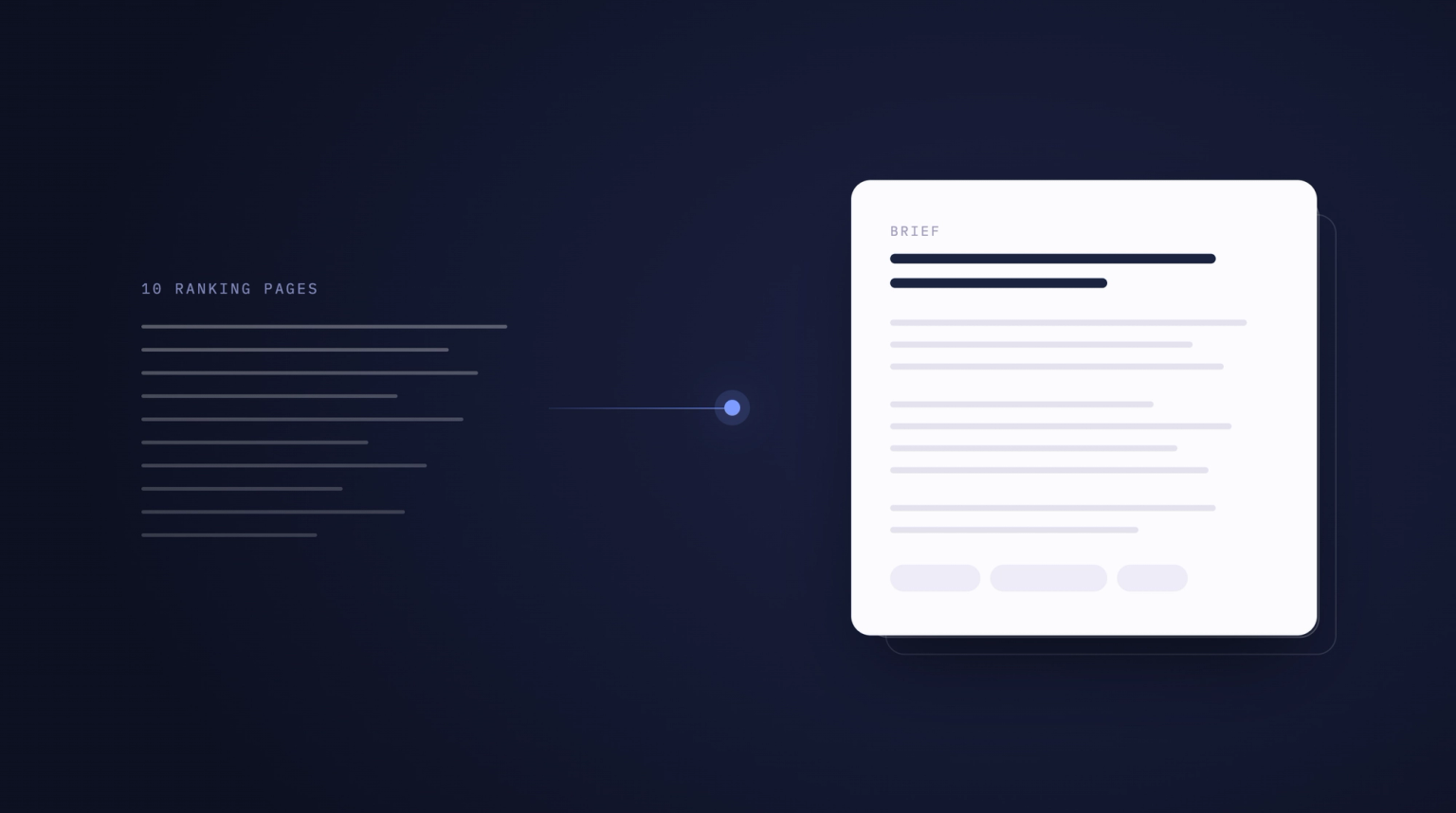
Fetches, reads, and analyzes the actual content of the top 10 results on the SERP
Suggests content angles that fit that intent
Recommends which of your features or benefits to introduce for that specific keyword
Writes multiple full intro options
Proposes body sections with its reasoning for each one
Below we'll walk through exactly what's in a Super Brief with a real example, and then cover the other AI content brief generators on the market if you want to compare. You can try Wave Writer yourself here.
What to Look for in an AI Content Brief Generator
If you want to avoid the problems above, and find a tool that produces very high quality content briefs, you need to look for the following features: .
Does it read the actual SERP, or just the keyword? A brief that ignores what's currently ranking is borderline useless because it can't tell you what Google is already favoring for that keyword. The SERP tells you this. You need to analyze it to have any shot at producing a good outline and ultimately article. . Also skimming the headlines of the top 10 results is not the same thing as actually reading the content and knowing the arguments the top 10 results make.
Does it analyze search intent and categorize the keyword? Knowing whether a keyword is a category, comparison, or jobs-to-be-done query changes the entire structure of the piece and how aggressively you pitch your product.
Does it identify which of your customer personas is searching and what pain point is driving the search? "Anyone Googling the keyword" isn't an audience. A solo blogger and a content director at a 500-person company can both search "ai content brief generator," and they need completely different pieces. Without a real persona, the brief won’t include anything that speaks to a real reader.
Does it understand your business substance, not just your topic? If the tool has no knowledge of your products, features, and positioning, its brief cannot tell a writer how to represent you. Your competitor could use the same brief and no one would notice.
Does it tell you whether and how to introduce your product? A brief that produces traffic-only content is a half-finished brief.
Does it explain its reasoning for each suggested section? Experienced editors need to know why a section was suggested so they can reorder, cut, or add with confidence instead of trusting AI blindly.
Does it stop at the brief, or also produce the draft? Otherwise you're paying for and switching between two tools.
How much editing does the resulting draft need? This is the ultimate test. If, during editing, you find yourself asking "why didn't I just write this myself?", the tool isn't helping you.
Wave Writer: An AI Content Brief Generator That Reads the SERP and Knows Your Business
Wave Writer was built by the founders of Grow & Convert, a content marketing agency that has built its brand on extremely high quality content for a decade. We're actual practitioners of content writing with high quality standards, not tech bros trying to make a quick app riding on the AI craze.
We call our briefs Super Briefs to play on the normal "content brief" everyone in the content and SEO space is used to. The difference is, normal briefs cover logistics only (word count, etc.). But we call ours “Super” briefs because they actually cover substance and argumentation.
No tool we've tested in this space does anything like it.
That thinking is what separates great SEO content from blah.
Below is each step of a Super Brief. I'll use the actual brief Wave produced for the keyword "ai content brief generator," which is the keyword this post you're reading is targeting.
Step 1: Brand Learning, So the Brief Is About Your Business
Before Wave generates a single brief, it requires you to upload comprehensive sources about your business. From those, it builds a detailed brand summary capturing what your business is, its features, your customer personas, the pain points it solves, and its competitive alternatives.
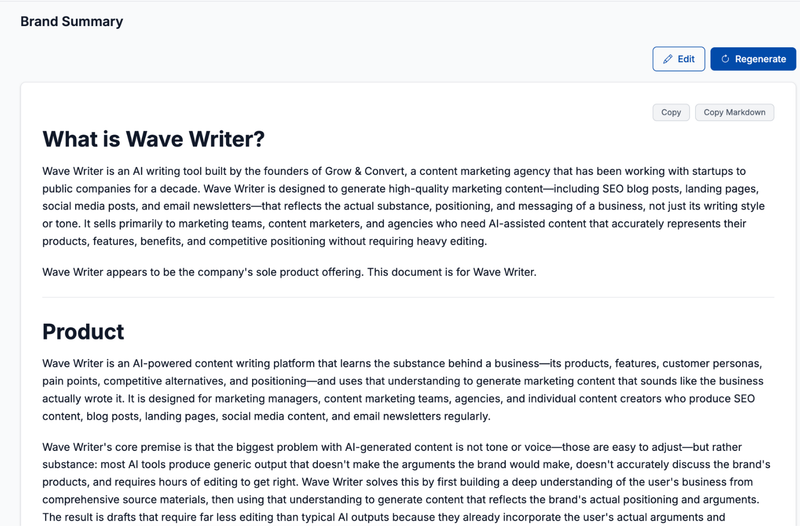
That brand summary isn't a black box. You can read exactly what Wave thinks it knows about you, correct anything it got wrong, and add nuances it missed. Everything it produces afterward, briefs, drafts, landing pages, social posts, is informed by that corrected understanding.
You can upload as many sources as the token limit allows, effectively 30 to 60+ depending on length. Compare that to Jasper's starter plan, which caps you at 5 knowledge assets. If you have multiple products, a few key positioning posts, and a couple of competitive comparisons, you'll blow through 5 fast.
This step matters because tone is easy to adjust. You do not need a dedicated tool to imitate your brand voice. ChatGPT can do that all day. What's hard is knowing which features to emphasize, what arguments to make, and how to position against alternatives. That's what separates a useful brief from generic filler.
One more thing on this: Wave controls exactly what the model sees and how it's prompted, so its understanding doesn't drift. ChatGPT and Claude projects start strong and then slowly revert to generic habits, which is why briefs you build in them get worse over time. More on that below.
Step 2: Search Intent Analysis (Who's Searching and Why)
Give Wave a keyword and it automatically determines who is likely searching, mapped to the actual customer personas in your brand summary. Not a generic "mid-level professionals in tech" guess, which is roughly the level of audience insight a free brief generator gives you when you type the audience in yourself.
It also categorizes the keyword using Grow & Convert's Pain Point SEO methodology into intent buckets: category keywords (bottom of funnel), comparison and alternative keywords, and jobs-to-be-done keywords (more top of funnel).
This helps your writer or AI tool understand how to write the draft in terms of how much to pitch or sell the product versus just teach. For example, a category keyword brief, like this one, leads with a detailed walkthrough of the product because the searcher is shopping for a tool. Whereas, a jobs-to-be-done brief leads with steps and mentions the product only where it naturally fits.
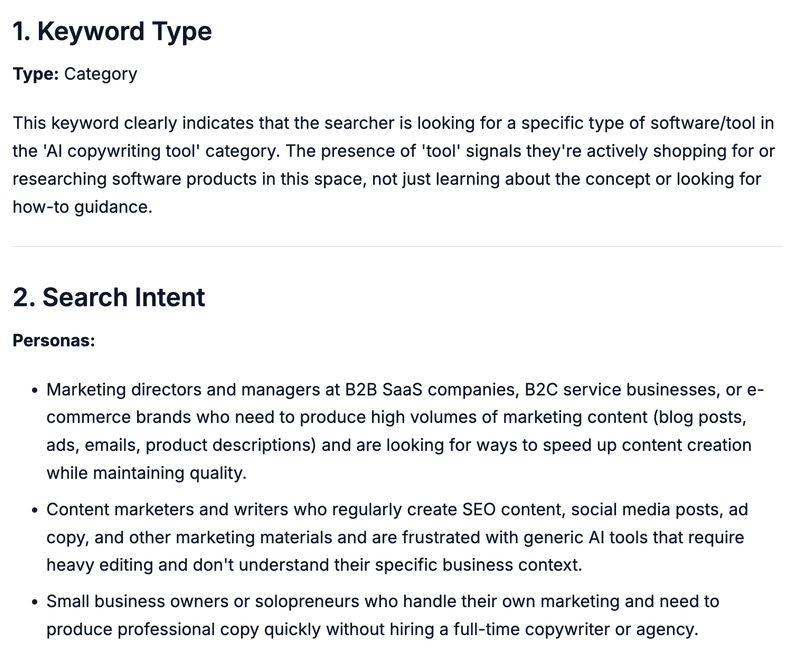
It also identifies the specific pain points driving the search. That's what lets a writer open the piece inside the reader's mindset instead of with a throwaway definition of what a content brief is.
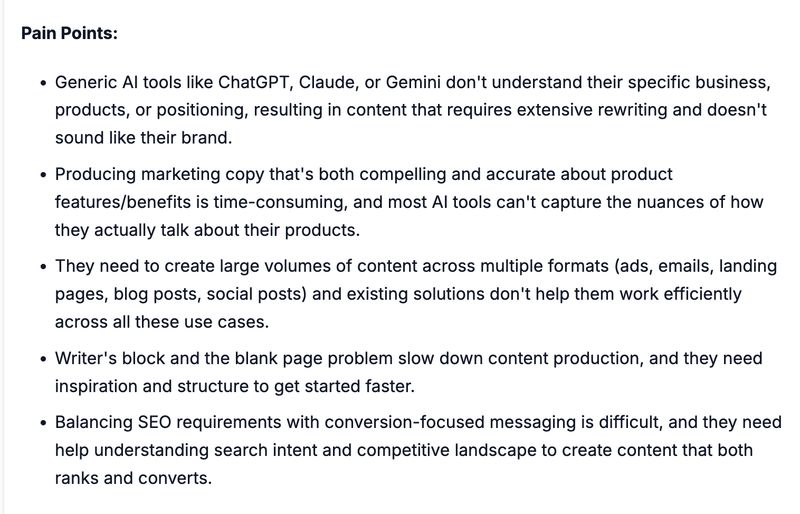
That grounds the brief in a real strategic framework instead of keyword density, which is what most brief generators substitute for strategy.
Step 3: In-Depth SERP Analysis (What's Ranking, and Where It's Weak)
Wave then fetches, reads, and analyzes the actual content of the first 10 results on the SERP. Not just the headlines. It reads the first 1,000 words of each piece.
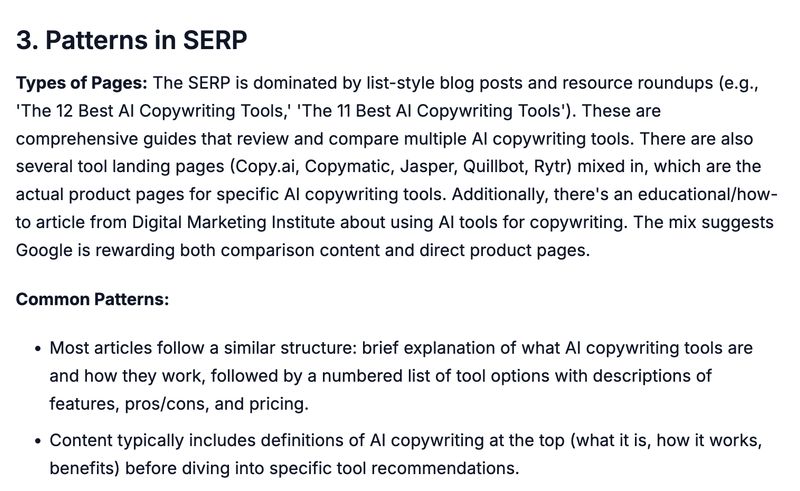
From that it reports:
What types of pages are ranking. Tool pages, roundups, landing pages, how-to guides. This tells you what format Google is rewarding for that specific query, which is often the single most useful piece of information in the whole brief.
What patterns exist in the arguments those pages make. Do they all define the key term up top? Do they all give a step-by-step process? Do they just sell their own product?
Most valuably, where those pages are weak. What a savvy searcher would want that the top results don't cover, and what they cover that the reader already knows and doesn't care about.
Having filtered through thousands of freelance writer applications and trained and worked with hundreds of writers over the years, we can say this is more in-depth than what most freelancers do when handed a keyword.
Step 4: Content Angles and How to Pitch Your Product
Based on the SERP analysis combined with its understanding of your business, Wave suggests strategic content angles that fit the search intent. It always gives you a "safest" angle that's closest to what's already ranking, plus a riskier, more opinionated angle meant to get your creative wheels turning.
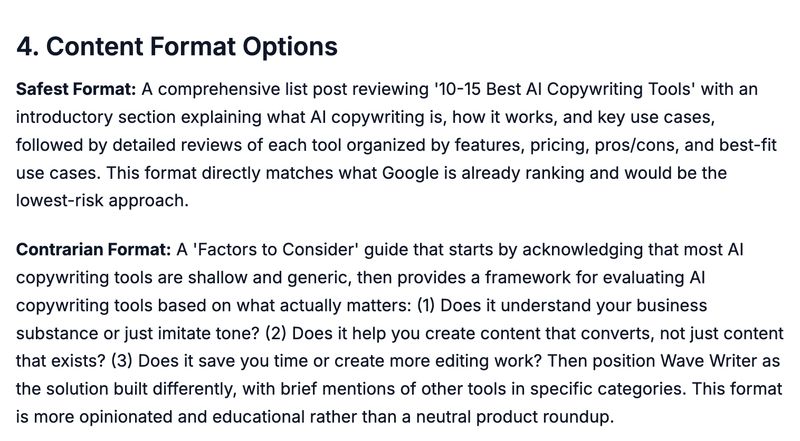
Then it recommends which of your specific product features or benefits make sense to introduce for that particular keyword, and which to leave out because they don't match the searcher's stage. It also shows how to work your perspective into the piece without forcing a sales pitch where it doesn't belong.
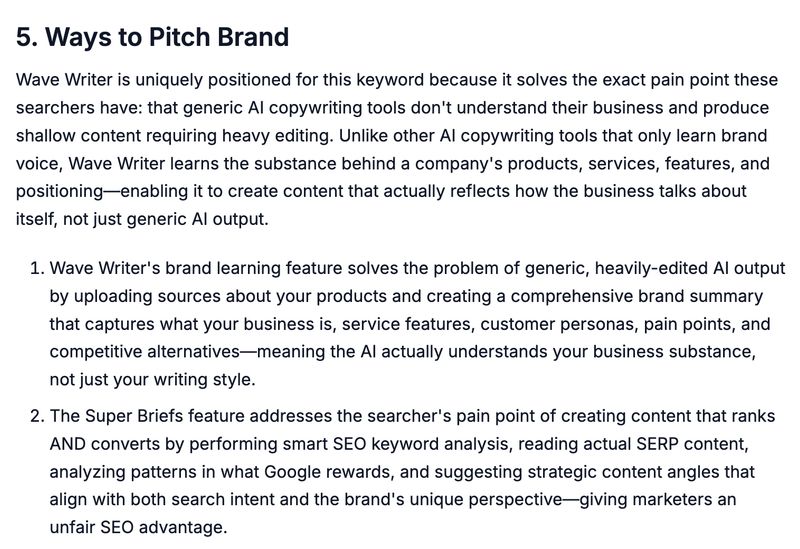
Most AI content brief generators don't even think to pitch your product. They can't. They don't know anything about it. And if they did think to, they wouldn't know how, because they're not built to have an in-depth understanding of your products, features, and benefits.
Step 5: Multiple Fully Written Intro Options
Super Briefs include multiple fully-written introduction options. Not a title suggestion, not a tone selection, not one generic opening. Several complete intros.
They're based on distinct intro frameworks taught to Wave by the writers at Grow & Convert from actual client work, and Wave has been taught when to use each one depending on keyword type and search intent. For example: a "factors to consider" intro for category keywords, a "better approach" intro when you have a contrarian take, and a "mistakes people make" intro for jobs-to-be-done keywords.
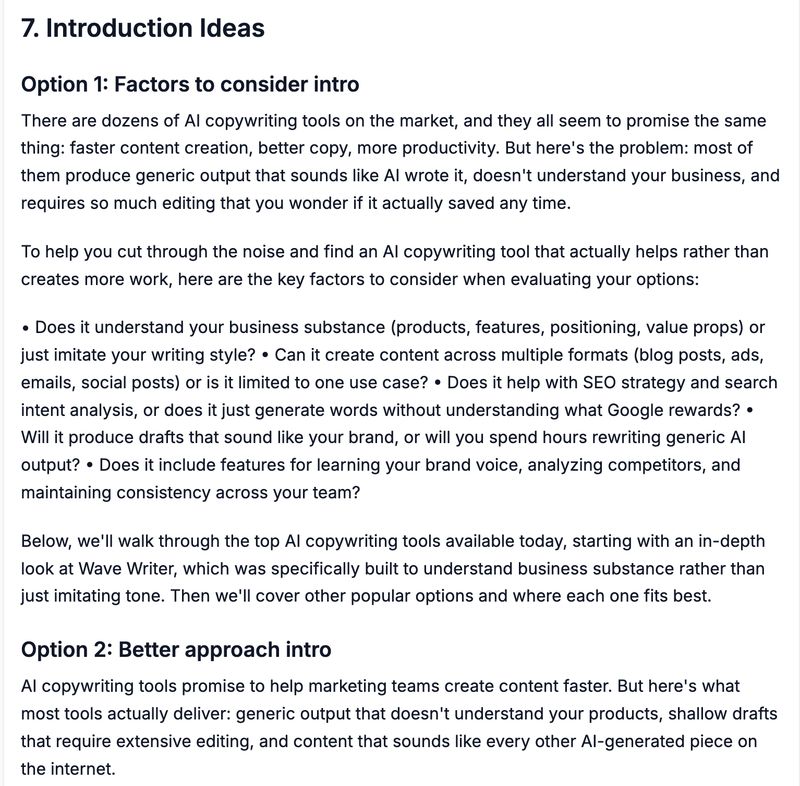
We're obsessive about intros because they decide whether someone keeps reading. And we're sick of bad AI intros (and honestly, bad human intros too). So we made sure Wave doesn't produce that slop.
Each intro is written to match the reader's mindset and set up the article's unique angle. Practically, that means whoever writes the piece starts with a real opening instead of a blank page.
Step 6: Body Section Ideas With the Reasoning Behind Each One
Instead of a single rigid outline, Wave suggests multiple body sections, each with an explanation of why it's included: how it supports ranking, how it satisfies search intent, or how it contributes to clarity and conversion.
It's designed as a buffet of ideas, not a fixed structure. A smart marketer can reorder, add, delete, or edit sections (although plenty of Wave users pass all of them straight through to a draft as is, and that's fine).
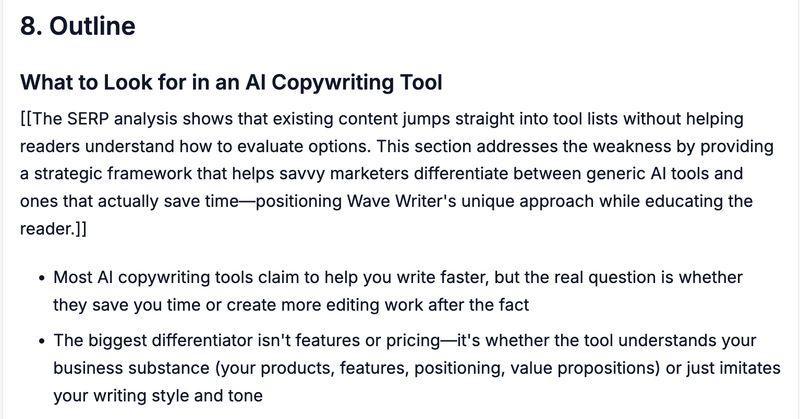
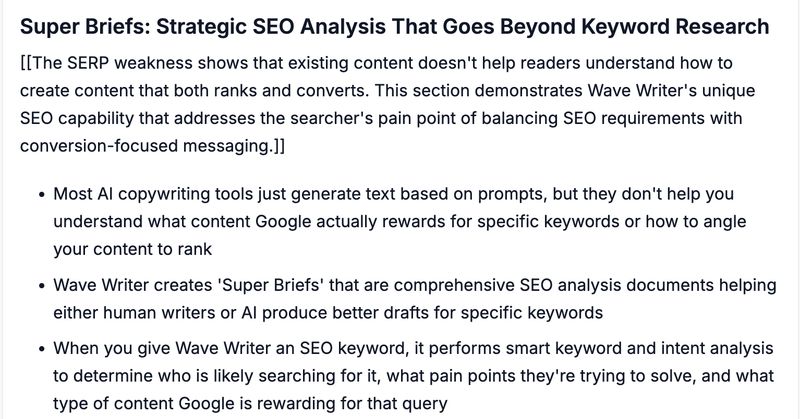
Because you can see the reasoning, you don't have to blindly trust AI. You understand what Wave saw and why it suggests it, and you can use your own judgment to agree or disagree. If a section was suggested because the top three results all include it and it aligns with intent, that's useful information. If you think it's wrong, cut it. Either way you're making that call knowing what the AI intended.
The supporting points under each section are also written as concise versions of the actual argument the section should make, not placeholder labels like "talk about X." So a freelancer knows exactly which claim they're defending.
Most AI tools just spit out copy and leave you to deal with it. If a section doesn't sit right, you have no idea why it was suggested. That's annoying, and it's one of the frustrations that led us to build this.
From Brief to Draft: Wave Also Writes the Piece
Nearly every tool on this SERP hands you a document and stops there. Wave closes the loop.
Once you have an outline, either from a Super Brief or one you wrote yourself, Wave turns it into a complete draft. No second tool, no second subscription, no copying the brief into a different app.
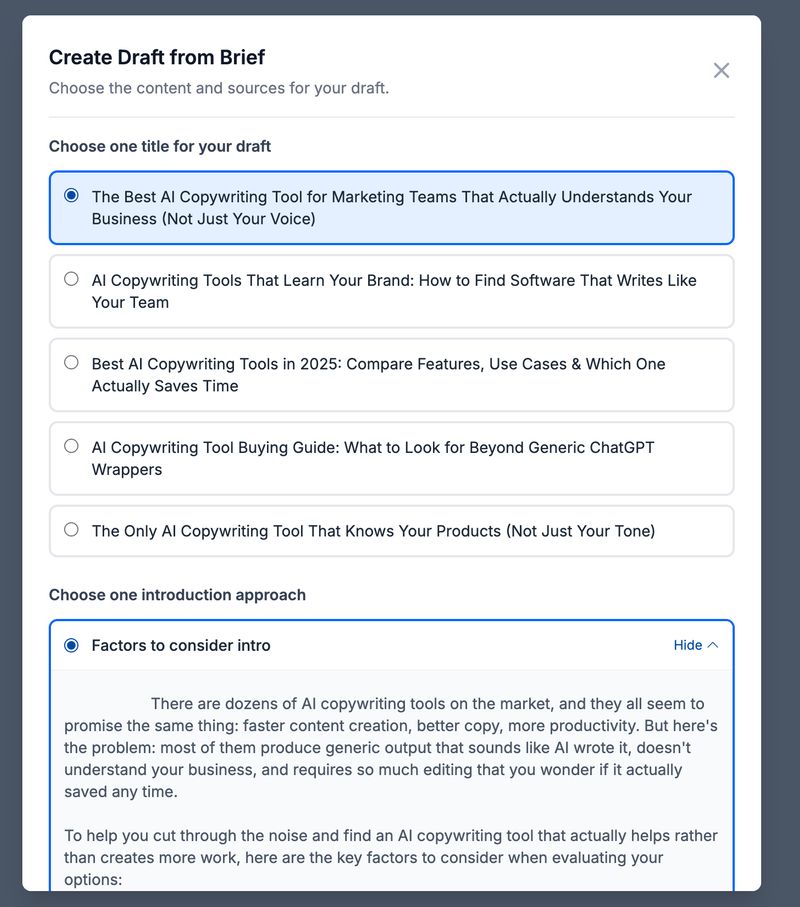
Wave has been carefully trained to follow outlines faithfully. If your outline contains a complete thought, it keeps that thought and builds around it rather than replacing your carefully considered argument with generic AI fluff.
When you give it rough, half-written ideas, even with typos, it fills in the blanks based on its understanding of your business. You can write "explain why our approach to X is different" and Wave will articulate your actual argument, not a generic version of it. In our own use at Grow & Convert, we'll write something like "explain the difference between strategy and tactics in the context of Pain Point SEO," and Wave doesn't explain it in a textbook way. It explains it inside our framework, because it has ingested that content.
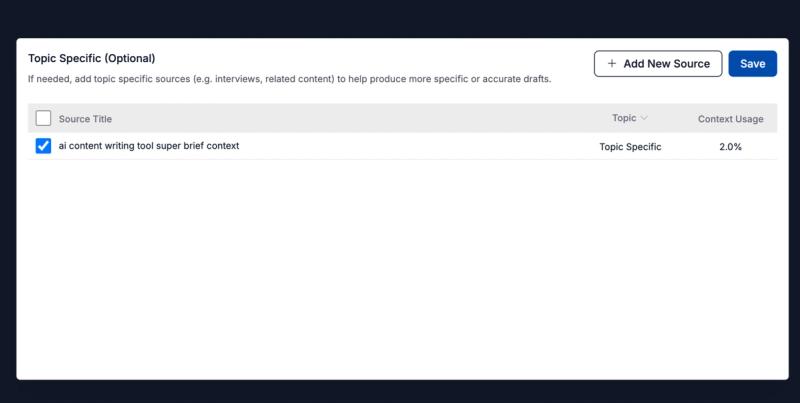
You can also attach specific pieces, interview transcripts, or background info for a particular draft to push quality even higher.
Editing happens in the same place. Wave has a built-in edit feature for both exact edits (when you know precisely what to change) and Wave-assisted revisions (when you want help rewriting a section), right in the draft, with version history. No juggling two tabs, copying a paragraph into ChatGPT, pasting it back, and discovering it lost the context of the surrounding paragraphs.
The result is a draft that needs refinement rather than a rewrite. Tools that understand your business substance get you 80% of the way there. Generic tools get you 40%.
Wave Writer Pricing
Wave Writer starts at $29/month for 10 outputs per month.
Every plan includes every feature: Super Briefs, content drafts, landing page copy, social posts, email newsletters. Nothing is locked behind higher tiers.
Every plan also includes unlimited brands and unlimited users, so an agency can set up a separate brand profile per client and the whole team can work in it without per-seat charges. And you can upload as many sources as the token limit allows, effectively 30 to 60+ depending on length.
For context: Jasper is $59/month for one seat with a 5 knowledge asset cap. Surfer is $99/month with AI writing as an add-on. Clearscope is $170+/month and doesn't write content at all.
The free brief generators cost nothing, which is a real advantage. But they don't read the SERP, don't know your business, and don't write the draft. The cost just shows up in editing time instead.
Other AI Content Brief Generators Worth Knowing
Quillbot's AI Content Brief Generator is free, requires no sign-up, and is genuinely fast. You type a prompt and get audience, tone, and key points back. It's a general-purpose writing utility, so the brief has no connection to a keyword's SERP or to your business. Fine for a quick starting structure, not a content plan.
SEO Review Tools' Content Brief Generator is free and more structured than most. It outputs a topic, goal, format, audience, five title suggestions, ten semantic keywords, a word count recommendation, and related questions. Useful as a pre-publish checklist. Still a template rather than a strategy document.
Moz Pro's AI Content Brief is the strongest of the mainstream options, because it's actually built on Moz's keyword and competitor data rather than a topic string. You get high-value keywords, primary search intent, key questions to answer, and a suggested structure. Two caveats: it stops at the brief, and it's a feature inside a broader paid SEO suite, so you're buying the suite.
Quattr's Content Brief Generator is free with credit limits, then $9.99 to $49.99/month. It lets you specify audience, article type, style, and word count, which is more input than most free tools accept. The premium-gated options and per-seat pricing add up quickly for a team.
Frase combines SERP research, brief generation, and AI writing from $45/month, which is solid value for solo creators who want the whole workflow in one place. Its keyword recommendations lack the precision of premium competitors, and the output needs substantial editing because it optimizes for topic coverage rather than your business substance. It helps you cover the right topics. Whether the resulting content makes your specific arguments is a different question.
Clearscope and Surfer SEO are excellent at what they were built for: telling you which terms and entities to include and scoring your coverage against what's ranking. But they're optimization-first tools with writing bolted on. At $170+/month and $99/month, you're paying premium prices for what to cover, not what to say. They're complementary to an AI writing tool, not a replacement for one.
ChatGPT and Claude are flexible and free, and plenty of marketers build briefs in them. In Grow & Convert's survey of how marketers use AI writing, ChatGPT was the #1 tool by a wide margin. So this is a fair alternative to consider.
Two problems kept surfacing when we tried it. First, they don't reliably read the context you load into a project. You upload your positioning doc and your best posts, then the brief misses a detail you specifically uploaded and you're typing "no, check the positioning doc, I explained it there." The only real fix is pasting your full context into every prompt, and no one has the patience for that. Second, they drift. The first few chats work great, then the tool slides back to generic "best practices" pulled from training data. In the same survey, over 60% of marketers said they either had to edit AI output "a lot" or "essentially had to rewrite" it.
Wave passes all the relevant context to the model on every interaction without you thinking about it, which is the specific reason its briefs don't degrade over time.